
Prescription Drug Affordability Board briefs Finance Committee on cost reviews, WACC penalty and potential price limits
Get AI-powered insights, summaries, and transcripts
Subscribe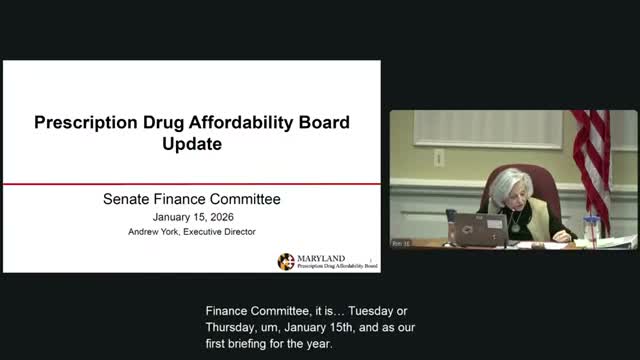
Summary
Dr. Andy York told the Finance Committee on Jan. 15 that the board has completed preliminary affordability determinations for two diabetes drugs and has recommended policy options — including an incentive to curb list‑price growth and plans to pursue upper payment limits — with final actions expected after public methodology review this spring.
Dr. Andy York, executive director of the Prescription Drug Affordability Board, told the Senate Finance Committee on Jan. 15 that the board has completed preliminary affordability determinations for two diabetes drugs and is preparing policy work and rulemaking that could lead to price limits for some prescription medicines.
"We are an independent state agency that's ... dedicated to making prescription drugs more affordable for Marylanders," York said, describing a five‑member board supported by a stakeholder council that expanded to 29 members. He walked lawmakers through the board's five‑step cost‑review process — data collection and outreach, dossier publication, board review and policy recommendations — and said staff will publish methodology and framework documents for public review before any final action.
The board has six drugs in its current cost‑review pipeline, York said: Farxiga and Jardiance (SGLT2 diabetes drugs), Ozempic and Trulicity (GLP‑1 diabetes drugs, studied here for diabetes indications), and Dupixent and Skyrizi (used for certain autoimmune conditions). York said the board made preliminary affordability findings in July 2025 for Farxiga and Jardiance and recommended several responses, including a so‑called "WACC inflation penalty," delinking certain PBM reimbursements from rebates and a patient navigator program.
Explaining the proposed WACC measure, York said WACC — the wholesale acquisition cost or list price — "is going up at a very high rate, substantially faster than inflation," while net prices have not risen at the same pace. "We want to look for incentives to keep that to kind of prevent that practice," he said, adding that the board is exploring metrics and guardrails rather than committing to a single approach.
York told senators the board intends to use domestic reference pricing (including the CMS maximum fair price where applicable) as part of its methodology and will post a methodology document for public comment. If the board approves a proposed upper payment limit (UPL), York said the action will go through standard rulemaking under the Administrative Procedure Act before taking effect.
Lawmakers pressed York on how the board defines an "affordability challenge." York said the board looks for a set of circumstances described in statute and in its dossiers: unusually rapid list‑price growth versus inflation, a drug's large share of gross spend for public purchasers, and disproportionate out‑of‑pocket costs for patients compared with net prices. He emphasized that the cost‑review process can also find that a studied drug does not cause an affordability challenge once more information is gathered.
Committee members also asked about stakeholder participation and public comment. York said PDAB uses informational hearings to allow extended, back‑and‑forth stakeholder input beyond short public‑comment time limits and that the board will solicit feedback as it streamlines the process for future review cycles.
York said PDAB is pursuing legislative and regulatory options to gain better access to PBM and payer data and called data sharing "the number one recommendation" from the board's report. "Even the payers in the state ... actually have no idea how much their PBM is paying for the drug," York said, adding that the board is exploring whether state law can require better reporting and transparency.
York also noted a statutory change discussed in the prior session (Senate Bill 357) that would expand PDAB's authority: if the board successfully implements UPLs for at least two drugs for at least one year, that authority could be extended to apply more broadly beyond state and local government purchasers.
The board expects to complete and close the first round of cost reviews this spring and to publish the dossiers and methodology documents that will precede any final actions, York said. He told the committee PDAB staff are working to streamline the process and aim to transition toward an annual review cycle.
The committee did not take any formal vote at the briefing. York said the board will continue to work with legislators and stakeholders as it finalizes methodology and potential rulemaking and will return with reports and documents for public review.