Get Full Government Meeting Transcripts, Videos, & Alerts Forever!
Get email alerts on the Marine Management topic
No spam. Unsubscribe anytime.
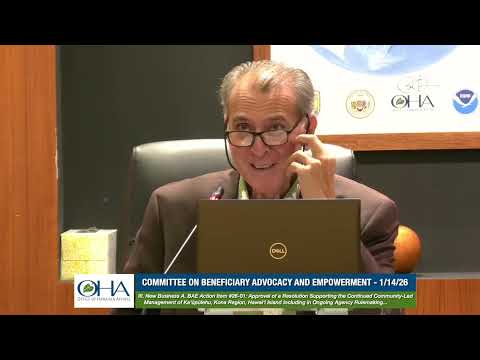
OHA trustees back continued community-led management of Ka'upulehu reserve
Summary
Trustees unanimously approved a resolution supporting Hui Kahua'i and community-led transition of the Ka'upulehu marine reserve into a Fisheries Management Area, endorsing community co-management and a timeline of BLNR public hearings this spring.
Trustees of the Office of Hawaiian Affairs voted to approve a resolution supporting continued community-led management of Ka'upulehu in North Kona and the community’s proposed agency rulemaking to transition the area from a 10‑year no‑take marine reserve to a locally managed Fisheries Management Area.
The move, approved by roll call with eight recorded yes votes, follows a presentation by Hui Kahua'i members including Hannah Kielani Springer and Kaikea Nakachi, who outlined a decade of monitoring, outreach and a management plan they say is designed to protect culturally important species while restoring sustainable subsistence fishing.
Hui Kahua'i representatives recounted the reserve’s origins and goals: the Tri Wait reserve was established in July 2016 as a 10‑year no‑take zone extending from the high‑water mark seaward to roughly 120 feet depth. Speakers described long‑term reef monitoring, community snorkel and scuba surveys with partner organizations and a multi‑year outreach effort. Kaikea Nakachi told trustees the group has conducted hundreds of events and recorded thousands of public and student contacts to support its management plan.
Trustees asked how the plan would support food security, the role OHA would play as a cooperator, and how upland hydrology and major landowners factor into protections. Presenters said the proposal is meant to work at an ahupua‘a scale — from summit to shore — and described existing collaborative relationships with Kamehameha Schools and state agencies. The presenters said they hope to request a Board of Land and Natural Resources (BLNR) public hearing in March, return to BLNR in May with revised rules as warranted, and then conduct public outreach leading up to the end of the reserve’s 10‑year period.
The trustees’ resolution expresses support for continued community leadership in management and for the ongoing agency rulemaking process. The resolution does not itself enact regulatory change; any rules moving from the reserve to a Fisheries Management Area would require agency action and BLNR approval.
Trustees and presenters said they will continue to coordinate on next steps and outreach; presenters urged trustees to remain available to support implementation and community engagement as rulemaking proceeds.