Middletown math leaders report curriculum realignment and early enrollment gains
Summary
District math leaders told the curriculum committee they have realigned grades 7–Algebra II to SAT and university expectations, launched a data-science class and a statistics course, and reported a 26% year-over-year increase in precalculus enrollment amid ongoing efforts to address post‑COVID proficiency declines.
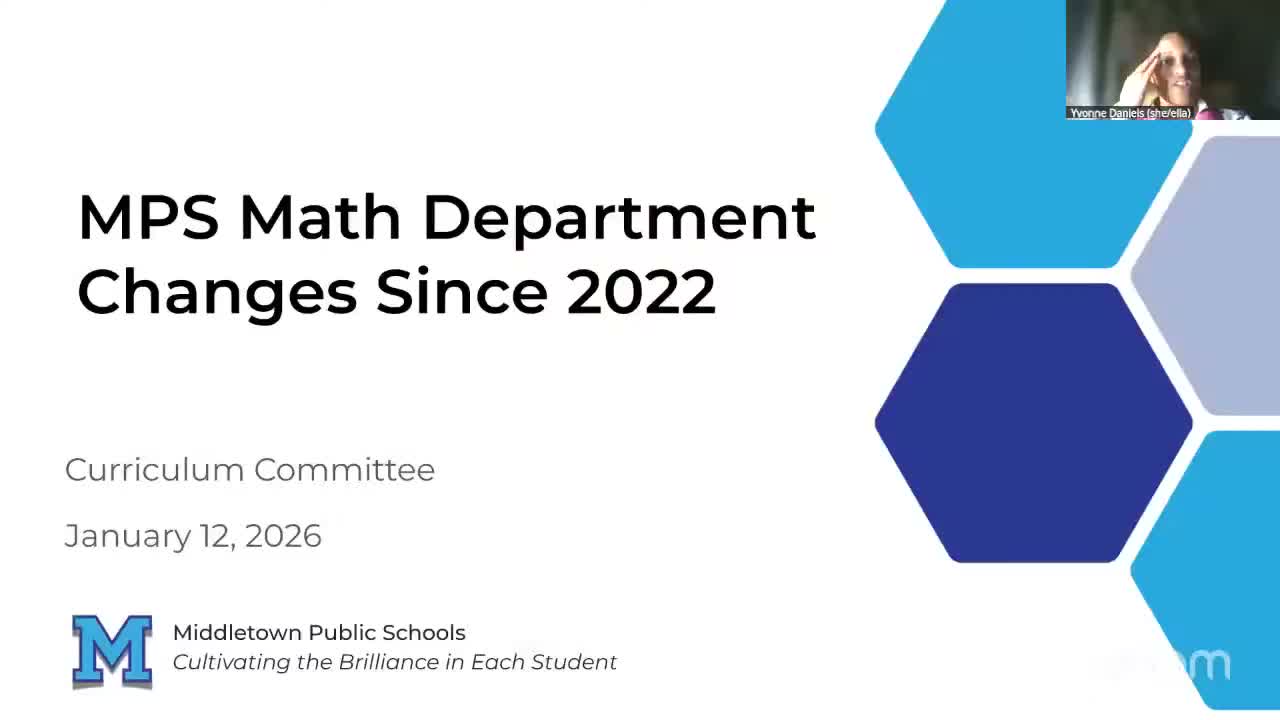
Rich Cordaway, director of the district’s math program, told the Middletown School District curriculum committee that since 2022 the math department has worked with a College and Career Math Consortium of university and out‑of‑district partners, parents and teachers to rework course mappings from grade 7 through Algebra II to align with SAT standards and university expectations. "So our algebra 1, our algebra 2, our geometry, our pre calc, and our data science were all mapped to boost the rigor in those classes," Cordaway said.
The district said several new or revised courses have board approval and are in early stages: a fundamental statistics course, a first-year data‑science elective, and an ECE (UConn) scribe math course scheduled to start next year. Cordaway and math supervisor Yvonne Daniels emphasized that the changes aim to close gaps in standards and improve students’ readiness for college coursework and state accountability measures.
The district reported a rise in precalculus enrollment after a 2023–24 redesign aligned with the curriculum consortium and recent College Board precalculus guidance. "This current year, we had 132 students enrolled in our precalc... That's 26% more students in the pre calc class than the previous year," Cordaway said, pointing to stronger retention into higher‑level classes as a key metric.
Board member Liz Crooks pushed back on whether the district’s work is sufficient to recover longer‑term proficiency losses. Crooks cited historical data that she said show grade‑11 proficiency of 28.8% in 2018 and a drop to about 15.4% in 2024–25. "I'm just wondering what's being done to address the decline in math scores," Crooks said.
Cordaway acknowledged the decline and described two strands of response: curriculum restructuring to restore rigor and targeted interventions. He said the district has offered an optional SAT course, restructured class placement and qualification criteria to ensure students are ready before advancement, and introduced math labs and project‑based interventions aimed at engaging students who previously disengaged from traditional remediation. "So we are increasing on our scores, not decreasing anymore," Cordaway said, while noting recovery is gradual.
Presenters also discussed AP offerings (AP Calculus AB, AP Computer Science Principles, AP Computer Science A, AP Statistics) and the difficulty of staffing some ECE partnerships. They said a combined UConn Calc 1/Calc 2 ECE offering is pending university approval and requires a teacher who meets UConn’s qualification standards.
The committee asked for cohort‑controlled SAT data to verify trends; Yvonne Daniels agreed to provide cohort slides and data for a future meeting. The district emphasized the multi‑year nature of recovery and said work will continue across pathways to support both accelerated and struggling students.