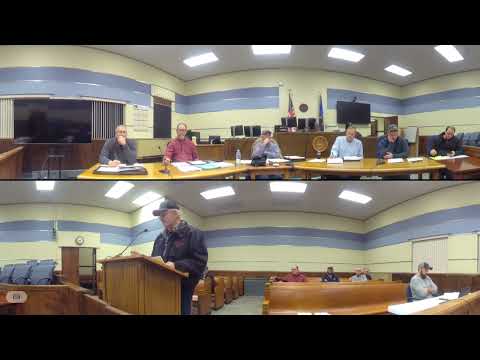
Emmons County adopts single conditional-use permit, sets fees and bond requirement
Loading...
Summary
After a public hearing and debate, county commissioners approved Resolution 25-12-01 to replace separate industrial and regular conditional-use permits with a single conditional-use permit, a 3% permanent permit fee (staged payments), and a bond rule (motion affixed a 10% construction-cost bond with a $500,000 floor); the planning and zoning board will refine details.
Emmons County commissioners voted to adopt Resolution 25-12-01 on a motion approving an amended conditional-use permit application that consolidates the county—s permitting structure and creates new fee and bond requirements.
The adopted changes replace separate "industrial" and regular conditional-use permits with a single conditional-use permit and set a permanent permit fee equal to 3% of the total project cost. The county will collect the permanent fee on a staged schedule: 25% due within 30 days of county approval, 50% due within 30 days of state (PSC) approval if applicable, and the remainder due 30 days before construction. Commissioners agreed the initial payment schedule and nonrefundable treatment of staged payments should be explicit in the final documents.
During public comment, Mandy Olsen of Strasburg, who said she has geology and oil-and-gas regulatory experience, warned that a flat $500,000 surety requirement could "stifle any sort of entrepreneurship or innovation" for small operators and residential entrepreneurs. County staff and several speakers said the $500,000 figure was a starting point developed while drafting the initial proposal; commissioners debated whether a fixed floor or a percentage-based bond better matches project risk.
Commission discussion centered on balancing local protections and practical enforceability. Speaker 2 (a member of the drafting team) explained the rationale: the fee and bond structure are intended to ensure the county recovers costs from permitting, notification and potential reclamation, and to provide a backstop where state bonding or regulation does not apply. "We are only going to have one conditional-use permit," Speaker 2 said in explaining the consolidation, and "the fee is 3% of the total project," a change meant to scale county revenue with project size.
The board debated bond design at length. The final motion, moved by Speaker 2 and seconded by Speaker 6, set a bond approach tied to project cost (the motion directed a 10% construction-cost bond), while keeping a $500,000 minimum referenced in the amendment discussion. Commissioners noted limits of bonding (for example, a bond—company—could become insolvent or a project's true reclamation cost could exceed a posted bond) but said requiring some bond is preferable to having none.
The resolution also formalizes administrative timing: the county auditor will review applications for completeness within 10 days; the planning and zoning commission will have 60 days to review and set a public hearing; and the planning and zoning board is expected to refine the zoning manual and related surveying and recording procedures. Several speakers requested adding explicit language that projects must follow state survey law (Century Code 43-19.1), and commissioners and counsel agreed to incorporate clearer cross-references in the zoning manual or application where appropriate.
The board approved the amended resolution by roll-call vote: Gardner, Miller, Adam Wilson, Baker and Materi voted Aye and the motion carried. The commissioners directed staff and the county attorney to update the written resolution and application language to reflect the agreed changes (payment schedule clarity, explicit nonrefundable bullets, bond language tied to project cost with waiver authority), then publish the finalized documents. The newly formed planning and zoning board will meet to organize and continue detailed work on surveying requirements, application specifics and any future bond/fee refinements.
The meeting concluded after the vote; commissioners proposed a first planning-and-zoning organizational meeting tentatively for Jan. 28 at 3:00 p.m.