Get Full Government Meeting Transcripts, Videos, & Alerts Forever!
Get email alerts on the In State Tuition Territories topic
No spam. Unsubscribe anytime.
Committee backs measure to require in‑state tuition for residents of U.S. territories, rejects reimbursement amendment
Summary
The committee reported HR6472 to the House after agreeing to an amendment in the nature of a substitute that extends in‑state public tuition to eligible residents of Guam, CNMI, American Samoa and the U.S. Virgin Islands; an amendment requiring federal reimbursement to states failed 14‑19.
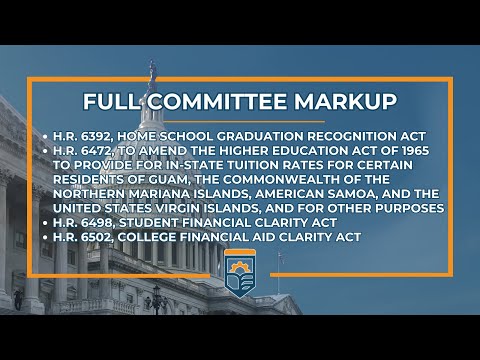
The House Education and Labor Committee on Thursday voted to report HR6472, a bill to require public colleges and universities to charge eligible residents of select U.S. territories no more than in‑state tuition, arguing the change would expand access to programs not available on some islands and help territories rebuild local capacity.
Representative Sablan Moylan (identified in the markup as Representative Moylan of Guam) explained the amendment in the nature of a substitute and said many territory residents face geographic and economic barriers to higher education. He said providing in‑state tuition would make it financially viable for students to pursue degrees otherwise unavailable at home and could encourage graduates to return and strengthen local economies.
Several committee Democrats supported the policy in principle but pressed for federal funding to offset any state revenue loss. Representative Adams proposed an amendment that would require the federal government to reimburse public institutions annually for revenue lost by offering in‑state rates to eligible territory students. Committee debate highlighted tensions between expanding access and imposing uncompensated costs on states.
The Adams reimbursement amendment was put to a recorded vote and failed, 14 yeas to 19 nays. The committee then agreed to the amendment in the nature of a substitute and voted to report HR6472 to the House; the clerk announced a recorded vote tally of 32 yeas and 1 nay.
Supporters framed the bill as a targeted step to expand educational opportunity for residents of Guam, the Northern Mariana Islands, American Samoa, and the U.S. Virgin Islands, while opponents warned the measure shifts costs to states without an appropriation.
The committee transmitted accompanying materials to the House for further action.