
Darien proposes five district instructional coaches, new universal literacy screener in FY27 budget
Get AI-powered insights, summaries, and transcripts
Subscribe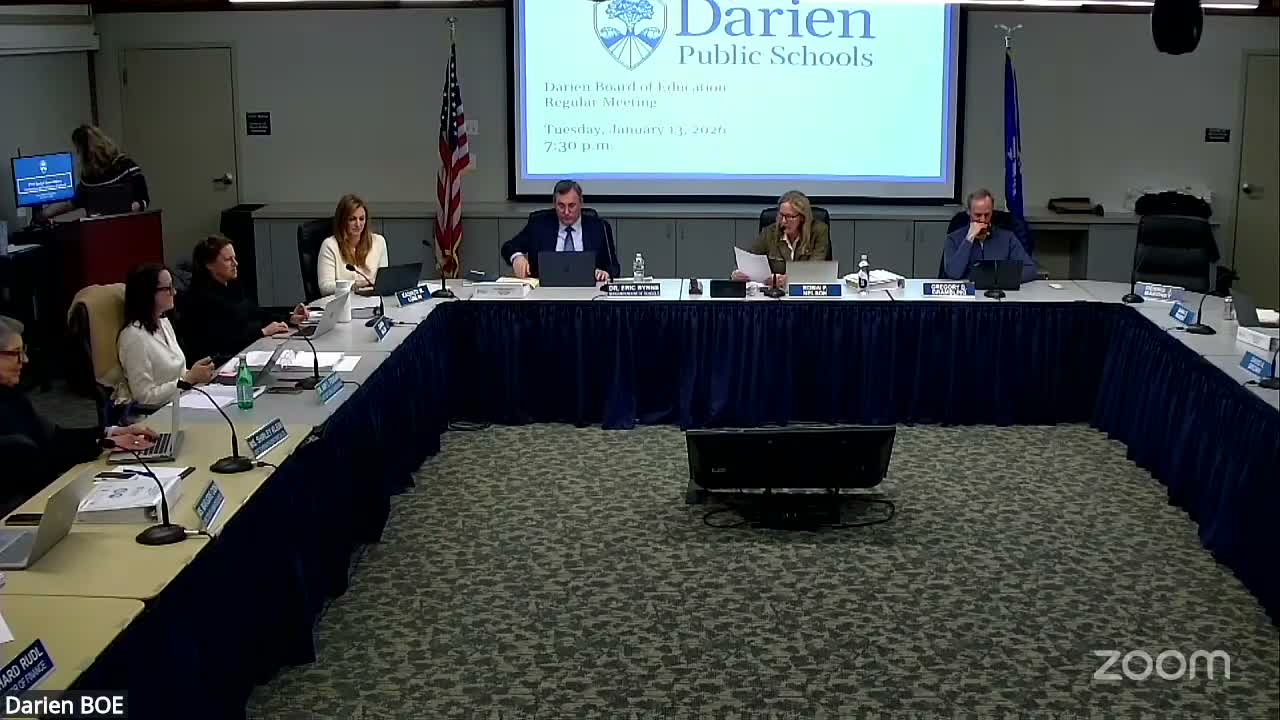
Summary
At its Jan. 13 meeting the Darien Board of Education reviewed the FY27 schools and curriculum budget, including a proposal to hire five district instructional coaches, adopt a different CSDE-approved universal literacy screener and implement a district data dashboard to support MTSS and family reporting.
Darien Board of Education members on Jan. 13 reviewed a proposed FY27 schools and curriculum budget that would add five district instructional coaches, adopt a new CSDE-approved universal literacy screener and expand MTSS- aligned data systems to help teachers and families monitor progress.
The budget presentation by district administrators framed the request as an investment in “human capital.” Board Chair Mrs. Nelson noted that roughly 80% of the district’s budget is personnel and benefits; the presenters said the coaching positions are intended to strengthen consistency of instruction across classrooms rather than replace school-level roles. “An instructional coach is a really hands on position. They work directly day in and day out with teachers,” the presenter said, describing coaches’ duties as modeling, co-teaching, lesson planning and using student data to inform instruction.
Administrators said coaches would be district-level employees supervised out of the district office and deployed across schools based on need and strengths. They described coaching cycles (typically multiweek engagements) and emphasized the non‑evaluative, supportive nature of the role: coaches will not conduct formal teacher evaluations or attend PPTs to act as evaluators, though they will help teachers analyze student data and shape classroom strategies.
The proposal is tied closely to the district’s MTSS (Multi‑Tiered Systems of Support) work and a planned change to the universal literacy screener. The presenters told the board that Connecticut’s “right to read” framework requires choosing from a CSDE‑approved menu of screeners; while the district’s current screener is on that list, administrators said it has been of limited instructional utility and that they are studying a different approved screener that would provide more actionable data (and include family reporting). “We are not currently satisfied with the universal screener that we have in place,” the presenter said, adding that a more useful screener is likely to be costlier and that some behavior‑screening costs previously covered by the state now appear in the district budget.
On measurement, the administration outlined three categories of metrics for coaching impact: implementation measures (for example, percentage of classrooms where the curriculum is implemented as intended and documented completion of coaching cycles), instructional quality measures (rubrics and observed classroom practice), and student outcomes (growth on screeners, benchmarks and standardized measures). They also plan to use a data dashboard—primarily an internal analytic tool—to triangulate assessments and support teacher and administrator planning; universal‑screener results would be shared with families beginning next year, while classroom‑level implementation percentages would not be released publically at the teacher level.
Board members pressed on operational details—how coaches will be deployed (districtwide vs. per school), whether they will deliver interventions or only model instruction, the length of coaching cycles, and recruitment timelines. Administrators said hiring could begin after a board decision in early February, with active searches and recruitment starting in March. They also noted the district will continue to align the coaching work to RCs across FY27 and revisit broader implementation in FY28.
The presentation and discussion did not include a final board vote on the FY27 budget; administrators said further RC‑level budget reviews and a curriculum committee meeting are scheduled in the coming weeks to provide additional detail.