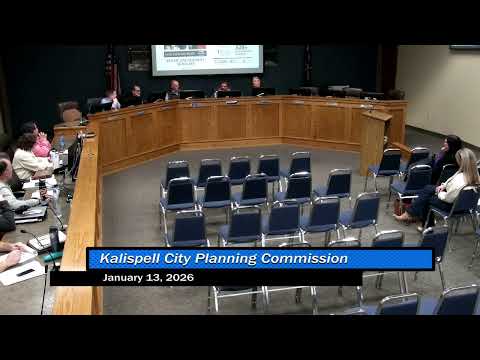
Planning commission recommends adoption of Kalispell Land Use Plan (Plan 2045) to council after public comment; vote 6–1
Loading...
Summary
After a multi‑part staff presentation and public comment, the Kalispell Planning Commission voted 6–1 to recommend the Kalispell Land Use Plan (Plan 2045) to the City Council; commissioners and public commenters focused on housing strategies, predictability for builders, outreach, and flood risk.
The Kalispell Planning Commission on Jan. 13 recommended that the City Council adopt the Kalispell Land Use Plan (Plan 2045), forwarding the staff report after a lengthy presentation, commissioner questions, and several public comments. The motion passed by roll call, 6–1; Commissioner Chad Graham voted no.
Staff framed Plan 2045 as an update required in part by the Montana Land Use Planning Act (MLUPA, Senate Bill 382), which changes how qualifying cities plan and process land‑use decisions. Donnie McBath, Planner II, told the commission MLUPA shifts certain project reviews to an administrative model and requires an adopted land‑use plan, a public participation plan, a future land use map and an implementation program. He summarized the plan’s chapters, which cover existing conditions, projected population and housing needs through 2045, community growth and design, housing strategies, local services and facilities, economic development, natural resources and hazards, the future land‑use map, and implementation.
Staff said outreach included about 40 stakeholder briefings, pop‑up events and open houses in March and July 2025, a consultant contract (Logan Simpson) funded by a Department of Commerce grant, and a public engagement website. Staff reported the outreach platform had over 38,000 page views, 702 participants and 223 comments; they also cited 212 questionnaire participants (the transcript includes an unclear consolidated response figure). The staff report recommends that the commission adopt the plan as presented and forward it to city council for adoption and subsequent ordinance and regulation updates required under MLUPA.
Public commenters included builders, industry representatives and environmental advocates. Keesa Davidson, a local builder and property owner, said she supports front‑loading a community plan to reduce repeated project‑level conflicts and urged concrete development standards to reduce cost and delay. Mark Friedline, executive officer of the Flathead Building Association, told commissioners that regulatory costs account for a substantial portion of housing prices and called the plan’s zoning and subdivision updates a step toward affordability. Frank Garner and Myrna Terry also urged predictability and efficiency to improve housing outcomes.
Adam DeYoung, speaking for Climate Smart Glacier Country, commended the plan’s treatment of flood risk and recommended that the city explicitly acknowledge flood risk beyond mapped 100‑year floodplains and consider joining FEMA’s Community Rating System (CRS) to lower insurance premiums and improve risk communication; staff responded that the plan contains multiple references to water quality and that adding specific language could be considered.
During discussion commissioners asked how conditional‑use permits and appeals will work under MLUPA. Staff explained discretionary decisions would still be reviewed under the same standards but processed administratively by staff, with appeals first to the planning commission and then to city council. The chair and some commissioners expressed concern that front‑loading public input could leave residents who move in later without a project‑level forum; staff and several public commenters said stronger, clearer standards and better outreach could reduce conflict while speeding approvals.
The roll‑call on the motion to adopt the staff report and recommend Plan 2045 to council recorded votes as follows: Rory Young Aye; Doug Kaufman Yes; Joshua Borgart Yes; Kate Walker Yes; Pip Burke Aye; Cody Hunter Aye; Chad Graham No. Staff noted a Jan. 26 council work session is scheduled and that the council must finalize regulatory updates by the statutory deadline (May 26, 2026) to comply with MLUPA.
Next steps: the Planning Commission’s recommendation will go to City Council for consideration; staff will prepare red‑line ordinance updates and additional materials as required by MLUPA.