Eureka planning commission reviews broad inland zoning code overhaul including design-review, parking and wireless rules
Loading...
Summary
The City of Eureka Planning Commission reviewed a comprehensive 2026 inland zoning code update that would shift many design reviews to administrative, add neighborhood meeting and large-site standards, raise bike‑parking minimums, adjust nonconforming-use rules, and rewrite wireless facility rules to align with federal case law.
The City of Eureka Planning Commission spent its meeting reviewing a broad update to the inland zoning code that would change how the city regulates design review, building form, parking and wireless facilities.
Staff presented the package and emphasized a central shift: many discretionary design-review hearings would be replaced by staff-administered reviews under objective standards. “Under the proposed changes, discretionary design review at a noticed public hearing would no longer be required,” an unidentified planning staff presenter said, describing a new neighborhood information meeting requirement and a 300‑foot notice radius for larger projects.
Why it matters: the change is intended to speed approvals and reduce discretionary triggers that often entail longer reviews and Environmental Quality Act review, but commissioners pressed staff on what public notice and accountability will remain. Commissioner comments repeatedly framed the trade-off between faster, more predictable permitting and fewer public hearings: one commissioner asked whether objective standards would leave adequate room for solving unique site constraints, while another said the change could ‘‘create a backstop’’ that developers might prefer to avoid costly discretionary processes.
Key provisions discussed include: - Design review and neighborhood meetings: Staff proposed that administrative, objective standards would govern most design review. For projects that would otherwise have no public notice, a neighborhood meeting would be required; the code would require applicants to demonstrate mailed notice to residents and a copy sent to the city’s development services department. - Building form and entrances: New massing limits would cap a public‑facing façade at 300 feet and require a major massing break every 150 feet. Buildings with public‑facing facades longer than 50 feet would be required to provide at least one entrance; staff said the intent is to promote pedestrian activity. - Transparency and ground-floor standards: The draft adds a 20% ground‑floor transparency minimum for residential buildings and strengthens entrance prominence and facade‑articulation requirements. - Large‑site standards and circulation: Projects with a development area of 1.5 acres or more would trigger internal circulation standards; sites of 3 acres or greater would face open‑space requirements and mid‑block connection expectations. - Parking and bike parking: The draft removes a redundant perimeter‑wall requirement and expands exemptions to support outdoor dining. It also raises bicycle‑parking expectations: a minimum of two bike spaces for non‑single‑family uses, long‑term covered bike parking, and e‑bike readiness for a share of long‑term spaces. Staff noted the changes support the city’s upcoming climate action plan. - Nonconforming uses and upgrade thresholds: Staff proposed valuation‑based thresholds for required upgrades when building permits are filed; the commission discussed exempting repairs from casualty (fire, earthquake, flood) from upgrade triggers and debated whether the suspension/abandonment period for nonconforming uses should be one or two years. - Accessory dwelling units: Updates required by state law were incorporated, including measuring size by livable space rather than floor area, per state guidance. - Wireless facilities: The update rewrites the wireless section to reflect federal case law and timelines. Small‑cell and building‑mounted installations that meet objective standards could receive administrative clearance; freestanding new towers would require a use permit regardless of zone, with heightened findings and alternatives analysis in sensitive areas (residential zones, historic districts). Staff said concealment standards were revised to discourage ‘‘artificial novelty’’ (for example, faux trees) that produce visual incongruity.
Staff and consultant Ben Noble fielded detailed technical questions during the presentation. ‘‘So in the code, what we say is a parapet, a raised edge, or a three‑dimensional architectural band that extends along the full length of the roofline,’’ Noble explained when commissioners asked how flat roofs could be made compatible with the new facade rules.
Public comment: One resident who identified herself as Miss Jackson said she preferred the tone of a prior community forum and urged the commission to consider how parking requirements affect infill projects. "Without that requirement, that building could have been put in the middle of that lot and avoided all the (neighbor) impacts," she said, referring to a specific five‑unit Bonar Street project.
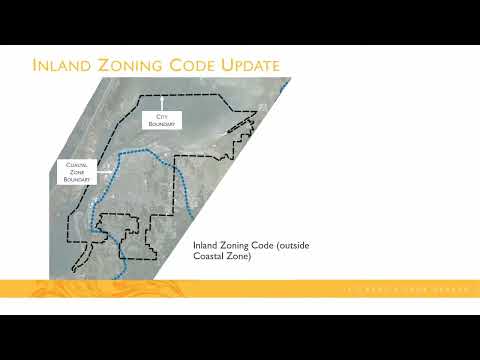
Next steps: Staff noted the inland code updates will be carried into a coastal zoning code update planned for adoption in 2026 and will be posted as required for public notice. The commission did not take any final legislative votes at this meeting; staff said they will return with formal hearing notices and any revised language.
This article is based on the Planning Commission’s presentation and discussion; direct quotes and procedural developments are taken from the meeting transcript. The commission adjourned at the end of the session.