
North Kingstown subcommittee details K–12 vaping curriculum and expands anti-vaping outreach
Get AI-powered insights, summaries, and transcripts
Subscribe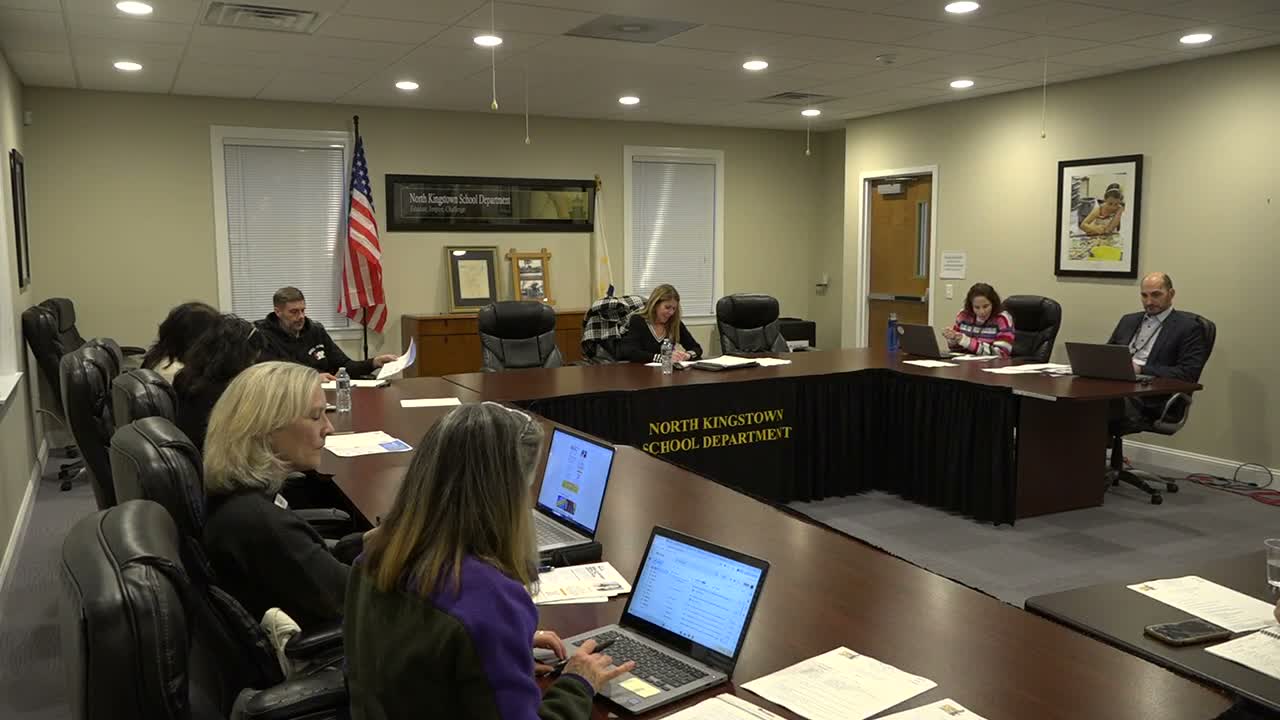
Summary
At its Jan. 14 meeting the North Kingstown Health & Wellness Subcommittee reviewed the district’s K–12 vaping curriculum, discussed enforcement and prevalence concerns, and approved a slate of outreach plans including a middle-school poster contest, 'what’s in the vape' kit, Tar Wars elementary visits, and a proposed parent series contingent on a Rhode Island Foundation grant.
The North Kingstown Health & Wellness Subcommittee on Jan. 14 heard an overview of the district’s health curriculum and discussed several anti-vaping outreach initiatives aimed at students and families.
Rob, the district’s assistant superintendent, presented the curricular scope and where vaping fits into it. He said age-appropriate substance education begins in kindergarten and progresses through elementary grades with units titled 'drugs are trouble' (grade 1), 'drugs are dangerous' (grade 2) and 'danger ahead — the truth about drugs' (grade 5). "In grade 7 students have a specific lesson on vaping and other tobacco products," Rob said, describing lessons that cover short- and long-term physical effects, addiction, secondhand smoke and the personal benefits of being tobacco-free. At the high school level, Rob said the Student Assistance Counselor delivers the Stanford Smart Talk prevention series to ninth graders, a five-topic program that includes cannabis prevention and media literacy about industry marketing tactics.
Committee members asked about instructional time and delivery; Rob said elementary health lessons are commonly delivered in an incremental block (roughly a two-week span each year) by phys ed/health teachers and that implementation can vary by school. Members emphasized that nurses typically do not deliver these classroom lessons. On prevalence and enforcement, Rob described reductions after statewide flavor restrictions as anecdotal and limited: "Anecdotally, maybe a little, but it's been minimal," he said, adding that vaping devices are designed to be hard to detect and enforcement in bathrooms and informal spaces remains a challenge.
Alongside the curriculum review, the subcommittee advanced a set of outreach steps:
- "What’s in the vape" kit and mobile display: The group reviewed a prevention-coalition kit and discussed creating a locally held kit or a wheeled cart to rotate displays among schools so teachers and students can see visual examples. Members suggested a storage or shadow-box display, possible in-kind donations of empty containers and using CTE or science teachers to source safe demonstration items.
- Middle-school anti-vaping poster contest: Subcommittee members and SAC representatives proposed piloting a poster contest at middle-school lunches to avoid interfering with instruction. Plans include setting contest parameters, involving CTE/graphic-arts students to design materials, and a check-out system for art supplies so students without materials can participate.
- Elementary Tar Wars presentations: Brown University Health agreed to deliver Tar Wars sessions to fourth- and fifth-grade classes (30–40 minutes) to align district messaging at the elementary level.
- Parent/community wellness series (Screenagers, anxiety supports, Hidden in Plain Sight): Ally Nacenzi outlined a proposed three-part series for parents that would include a Screenagers screening, a Parent Services Network presentation on youth anxiety and school avoidance, and a Hidden in Plain Sight demonstration showing common hiding places for substances. Ally said she has drafted a grant request to the Rhode Island Foundation for $20,000 to underwrite the series and that the request is pending; she said she aimed for a modest request within the foundation's funding spectrum to improve competitiveness.
Committee members also suggested low-cost alternatives and community-focused venues to boost attendance if grant funding is not secured, including an outdoor screening at the town beach before summer. Members agreed to pursue costing, logistics and scheduling for the various activities and to coordinate messaging to parents via principal newsletters.
The subcommittee approved the meeting minutes from Dec. 9, 2025, by voice vote and adjourned. The next meeting is scheduled for March 19, 2026.
What remains unresolved: the outcome of the Rhode Island Foundation grant application was not specified at the meeting; cost estimates and final logistics for the kit, poster contest materials and any stipend or purchase orders are pending further follow-up and possible school committee approval.