
Harford County executive touts fiscal restraint, public-safety investments and new infrastructure in 2026 address
Get AI-powered insights, summaries, and transcripts
Subscribe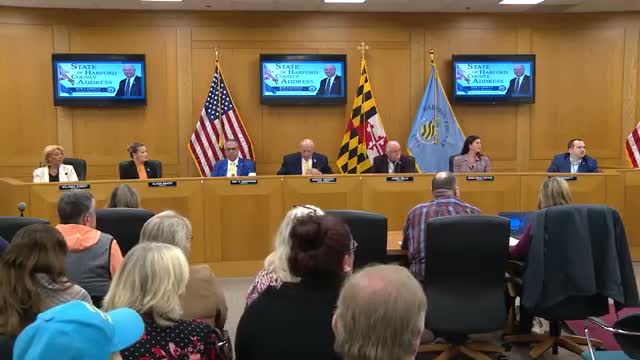
Summary
County Executive Bob Casley framed fiscal restraint as his priority, touted retained bond ratings and awards, announced a volunteer firefighter cancer-screening program and a Woodley Road construction timeline, and outlined education and transit investments.
County Executive Bob Casley delivered Harford County’s 2026 State of the County and legislative address, foregrounding fiscal restraint, public safety and targeted infrastructure projects.
Casley said his administration chose efficiencies over tax increases after inheriting what he described as a large structural deficit early in his term, and credited county officials for retaining the county’s bond rating and winning awards for budgetary transparency. “Always do right,” Casley said, invoking a sign from his father that he described as his guiding principle.
Why it matters: Casley framed the next year’s budget around public safety and education and signaled resistance to higher taxes to fund outside-entity spending requests. He also announced several operational and capital initiatives that could affect county services and local construction schedules.
Casley highlighted public-safety investments, including competitive pay for deputies, upgraded radios and new vehicles, and an expanded EMS program. He said the county now has 17 active ambulance units answering about 30,000 calls per year and that response times are typically under eight minutes. He described one recent emergency where paramedics used rapid sequence intubation (RSI) to stabilize a crash victim and thanked EMS chief Caitlin Ledford and Captain Natalie Stottler for their work.
The executive announced a new county-funded volunteer firefighter cancer-screening program intended to address occupational cancer risks among volunteer firefighters. “Our volunteers do an amazing job working selflessly together,” Casley said as he recognized volunteer officers in the chamber.
On transportation, Casley described coordination with the State Highway Administration, signal-synchronization work on major corridors, and a plan to put the Woodley Road project out to bid in February with construction expected this summer to divert truck traffic from Perryman Peninsula neighborhoods.
Casley also pointed to operational gains in transit: after deploying route-routing software, officials increased ridership to about 414,000 passengers while reducing annual mileage by roughly 200,000 miles; he said 88 percent of transit operations are funded by federal and state grants.
Education remained a central theme. Casley said the administration funded the superintendent’s FY26 budget, negotiated a three-year budget deal with the Board of Education and will send a FY27 budget fully funding a 6.5 percent increase. He said Harford County is on track to meet the state-mandated $60,000 starting teacher salary.
The address also covered parks and open-space acquisitions (Casley cited a recent purchase of 129 acres in Joppa and preservation of thousands of acres of farmland), the county’s new PFAS-certified lab for water testing, and planned recreation- and trail-related projects including a proposed Okungen Peninsula Park system.
Casley closed by urging restored coordination between executive and council offices and reaffirming priorities for 2026: fiscal responsibility, public safety, education and economic opportunity. He said he will oppose tax increases to cover outside spending demands and asked the council to continue working collaboratively on the coming budget cycle.