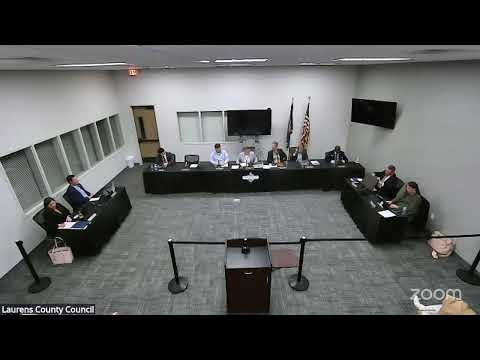
Laurens County council trims open-space mandate, approves package of zoning amendments
Loading...
Summary
On Jan. 12, 2026, the Laurens County Council approved a set of amendments to the county's open-space residential development ordinance (Ord. 991), lowering the open-space requirement from 60% to 50% and adopting changes to setbacks, lot orientation and access rules after extended debate and individual amendment votes.
On Jan. 12, 2026, the Laurens County Council voted on a package of amendments to Ordinance 991 (the county's open-space residential development rules), approving a revised open-space requirement and several technical changes after extended discussion and multiple roll-call/voice votes.
The council ultimately approved a substitute to amendment 3 setting the open-space requirement at 50% of a development, with 40% designated as natural open space and 10% as common open space. The substitute motion passed by a 5-1 vote; Councilman Brownlee was recorded in opposition. During debate, Paul Harrison, a civil-engineering partner who represents developers, warned the initial 60% requirement was infeasible, saying, "60% open space right off the bat is is pretty substantial amount of open space," and argued it would harm affordability in areas served by public water and sewer.
Council considered 11 proposed changes drawn from outside stakeholders (developers, engineers and utility providers) and staff input. Staff and the county attorney described the amendments individually before votes. Several technical changes cleared with broad support: amendment 2 increased land-use buffers to 100 feet in most directions (with a reduced 50-foot buffer along common property lines where an existing subdivision already has a 100-foot buffer) and passed 6-0. Amendment 4 reduced side-yard setbacks (to 7.5 feet for 1.5-story structures and 10 feet for 2-story structures) to modestly increase potential density; that amendment passed by voice vote with one dissent. Amendment 6 allowed intermediate turnarounds or traffic circles on long dead-end streets as an emergency-access option and passed 6-0.
Other votes altered layout rules: the council removed a requirement that exactly 50% of lots must directly face open space (amendment 1a, passed 5-1), changed the subdivision entrance standard from one entrance per 50 lots to one entrance per 100 lots with a proposed maximum of four entrances (amendment 5, passed 5-1), and permitted unfenced stormwater retention/detention ponds to count for up to 3% of common open space if designed with pedestrian amenities (amendment 9, approved with two members recorded as opposed). Amendment 10 added a requirement that developer maintenance plans for open space be approved by the county; it passed after clarification of a drafting error.
Council also approved a separate motion to increase the streetscape buffer (page 5, section d, item 3) from 50 to 100 feet, with 40 feet landscaped and the balance eligible to count as natural open space; that motion carried by the margin recorded in the transcript (5-1). County staff emphasized the streetscape can include sidewalks, trails and passive-recreation features and that the maintenance plan will be county-reviewed.
The council concluded the amendment-by-amendment process and approved Ordinance 991 on second reading (the amended ordinance will return for third reading after a workshop). The transcript records the second-reading vote as 5-1, with Councilman Yount in opposition. The board scheduled a workshop to review the revised draft before third reading.
Why it matters: the changes lower the percentage of required open space from the earlier 60% proposal to 50%, ease setback and access rules, and give developers additional flexibility for open-space placement and stormwater design. Supporters said the package makes open-space subdivisions more feasible and affordable; opponents warned the changes risk reducing protections for natural areas and altering neighborhood character.
What comes next: staff will revise the ordinance package for a workshop and subsequent third reading; the council indicated it could schedule a special call meeting after the workshop if further action is needed.