
Ways & Means frames March yield bill with focus on revenue mix, one-time funds and income sensitivity
Get AI-powered insights, summaries, and transcripts
Subscribe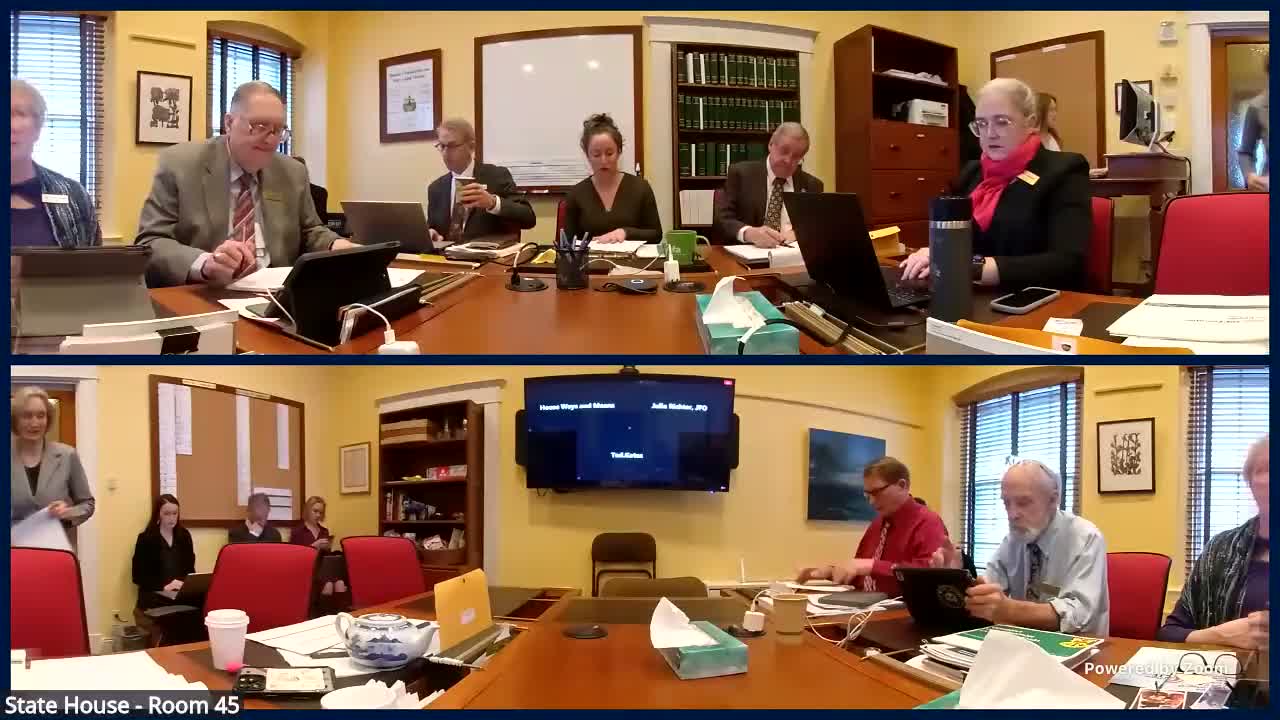
Summary
The Ways & Means Committee reviewed high-level decision points for the March yield bill, including which non-property revenues to count, whether to use one-time funds to cut property taxes, and how to set homestead and non‑homestead yields and the income-sensitive property tax credit.
The Ways & Means Committee met Wednesday to frame the decision points it must resolve before drafting the March yield bill, focusing on how the state will fund the Education Fund and how tax changes would affect homestead and non‑homestead property taxpayers.
Julia Richter, the committee’s designated financial officer, told members the yield bill “determines how to raise funds for the education fund after accounting for all of the uses and all of the non property tax revenue streams.” She said the committee should treat the yield bill process as a set of policy decisions — not a technical fix — about which revenue streams to rely on and how to allocate burden across taxpayer groups.
Why it matters: Richter stressed that choices about one‑time money and non‑property revenue streams have carryover effects. “The more one‑time money that is used in one year, the larger of a gap the next year needs to make up,” she said, noting that more than $100 million of one‑time transfers were used last year to buy down property taxes.
Members pressed specifics. Representative Berger asked how assumed grand‑list growth is calculated and whether incentive programs such as CHIP and TIF change that assumption; Richter said those growth assumptions come from the tax department’s equalization study and deferred detailed methodology questions to tax staff. Richter also cautioned that isolating growth “but for” an incentive requires careful analysis.
Non‑property revenues drew detailed discussion. Richter said the short‑term rental surcharge has been folded into the meals‑and‑rooms line in the outlook; she also said repeal of certain service exemptions (sometimes called the “cloud” tax) would appear in the sales‑and‑use line. She warned that depending on when a revenue source is implemented, it may not produce collections in the coming fiscal year.
The committee discussed current‑use treatment and tax expenditures. Richter said the current‑use program operates as a tax expenditure (an exemption) that reduces property tax revenue and can be presented in outlooks as such; members also noted a $20 million general‑fund municipal hold‑harmless appropriation that offsets part of that effect.
On income sensitivity, Richter described the income‑sensitive property tax credit embedded in homestead calculations and asked the committee to choose whether that income yield should produce the same average bill change for income‑sensitive households as for others — a policy decision with distributional consequences.
What’s next: Members requested more granular data from the Agency of Education and the tax department, including updated revenue forecasts and equalization details, before finalizing yield‑bill choices. The committee paused for a break and scheduled an Agency of Education presentation after the recess.