Get Full Government Meeting Transcripts, Videos, & Alerts Forever!
Get email alerts on the Probable Cause Regulation topic
No spam. Unsubscribe anytime.
FPPC delays vote on probable-cause rule changes after due-process objections
Summary
The Fair Political Practices Commission postponed action on proposed amendments to probable-cause procedures after public commenters and several commissioners raised concerns that removing document production and witness participation could harm respondents’ due process and reputations; the item was sent back for further stakeholder engagement and return in March.
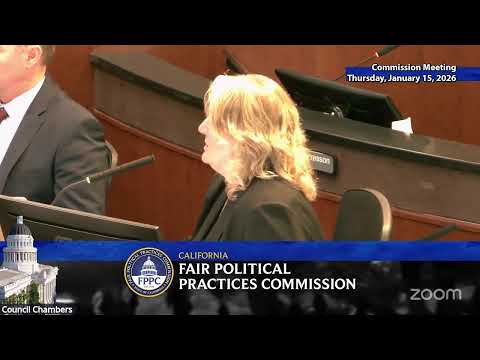
The Fair Political Practices Commission on Jan. 15 postponed action on proposed amendments to Regulation 18361.4 that staff said would speed probable-cause proceedings by removing provisions for document production, limiting witness participation and imposing firmer deadlines.
Senior Commission Counsel John Fizer told the commission the changes are meant to “return the probable-cause process to its statutory intent” under Government Code section 83115.5 and to avoid unnecessary delay and expense caused by formal discovery at the preliminary stage. He said probable cause is intended as a gatekeeping step, not an adjudication, and that respondents retain full administrative-procedure act protections later in the process.
Members of the regulated bar and outside commentators urged caution. Casey Jenkins of the California Political Attorneys Association asked the commission to postpone action and work with staff, arguing that discovery and a neutral forum at the probable-cause stage allow respondents to identify evidentiary gaps and reach more informed, efficient settlements. “Providing a fair hearing consistent with the right to due process includes providing discovery to respondents, allowing witnesses to testify, and conducting the hearing in a time frame considerate of everyone’s schedules,” Jenkins said during public comment.
Gary Winick of the Kauffman Legal Group echoed that view, saying he has observed probable-cause conferences produce settlements or case closures after counsel for both sides test the evidence. “Discovery, witnesses and the other protections that are set out here are really an irreplaceable part of this,” Winick said.
Commissioners debated the tradeoffs between speed and reputational risk. Commissioner Brandt, while supporting swifter enforcement overall, urged caution about removing protections for unrepresented respondents who may not understand the preliminary nature of a probable-cause conference. Commissioner Zettel repeatedly flagged the potential for reputational harm if a matter is publicized without giving respondents access to the evidence being relied on against them. Commissioner Ortiz described his conflicted view, balancing reputational concerns against the public expectation that enforcement cases be resolved in a timely way.
Chair Silver signaled a preference for additional stakeholder engagement before acting, saying he believed “a delay to the March meeting would be the ideal next step.” With multiple commissioners urging staff to meet with CPAA and other interested parties and to consider addressing proposed changes one at a time, the commission did not adopt the amendments at this meeting.
Staff said they will return with revised proposals after further consultation. John Fizer and Chief of Enforcement Kendall Bonebrake told commissioners they remain available to work through specific items, and commissioners asked staff to present each proposed change separately so the commission can deliberate (and vote) on document production, witness participation and timing provisions individually.
What’s next: the FPPC will accept additional written comment and stakeholder input and expects to revisit the proposed amendments at a future meeting, with staff aiming to return in March for further consideration.