
Newberg board hears boundary committee recommendation: pursue local option levy or restructure to address falling enrollment
Get AI-powered insights, summaries, and transcripts
Subscribe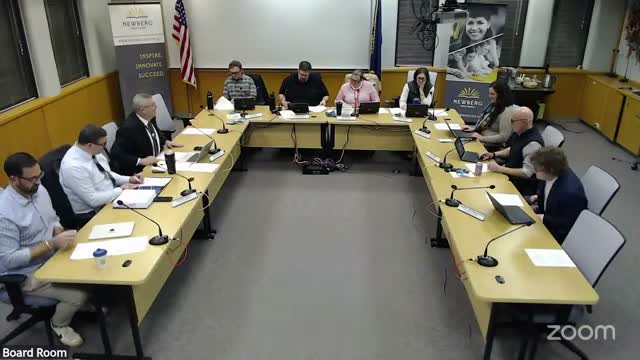
Summary
Superintendent Dave and a 50‑plus person boundary committee presented options to address an 18.86% enrollment decline since 2019, recommending either a local option levy or a package of restructures (including making Edwards a dual‑language magnet and potential closure of Ewing Young) projected to save about $2.1 million.
Superintendent Dave presented a boundary committee report on Jan. 13, telling the Newberg School District board the district faces a structural problem: shrinking and uneven elementary grade‑level cohorts that create unstable class sizes.
The committee, convened in October and involving more than 50 parents, teachers and administrators, modeled multiple configurations and recommended the board consider a local option levy or a combined restructuring package to restore financial stability. "Waiting is just going to make this problem harder," Dave said during the presentation.
Why it matters: the district reported an 18.86% loss of students since 2019 and cited falling birth rates statewide; small cohorts mean some elementary grades have only two sections, which leaves the district vulnerable to single‑year enrollment swings that can push classes above 30 students or force costly midyear staffing changes.
What the committee evaluated: options considered included k–4/5–6/7–8 splits, k–2/3–5 models, k–6 configurations and maintaining the status quo. Committee members said each option has trade‑offs—especially on busing, neighborhood integrity and additional student transitions—and no one option fully solved the grade‑level instability.
Recommendation and numbers: the committee voted 25–1 to recommend exploring a local option levy as one path forward. The committee also recommended a package of changes (including making Edwards a dual‑language magnet to consolidate dual‑language sections and shifting students into Joanne Austin, Crater and Dundee) that the superintendent said would yield about $2,100,000 in savings toward restoring fiscal stability.
Levy mechanics and budget context: the superintendent explained a local option levy is a voter‑approved property tax assessed per $1,000 of assessed value and may be collected for up to five years before renewal. He outlined preliminary targets: roughly $1.3 million to restore five furlough days, about $2.29 million for already‑agreed cost‑of‑living adjustments and a goal to restore an ending fund balance near 2.5% (~$4.5 million) and ultimately approach the board’s 7% policy target (~$7.4 million).
Next steps: staff will return with more detailed itemizations and communications materials. The board was told first readings and motions will be scheduled at the late‑January meeting (materials and draft language to be provided on Jan. 27), a decision point on restructuring is expected Feb. 10, and the final date for a potential levy election would be May 19 if the board places a measure on the ballot.
Board members asked for an itemized breakdown of the $2.1 million savings estimate, clarification on what would change if a levy passes, and more precise five‑year revenue/cost projections. Dave said staff will provide spreadsheets, FAQs and polling results to support the board’s deliberations.
The board did not take a vote on a levy or restructure at the Jan. 13 meeting; members directed staff to return with more data and outreach materials.