
Pennsylvania Horticultural Society to pilot vacant-lot greening in Chester, aims to stabilize 100,000 sq ft
Get AI-powered insights, summaries, and transcripts
Subscribe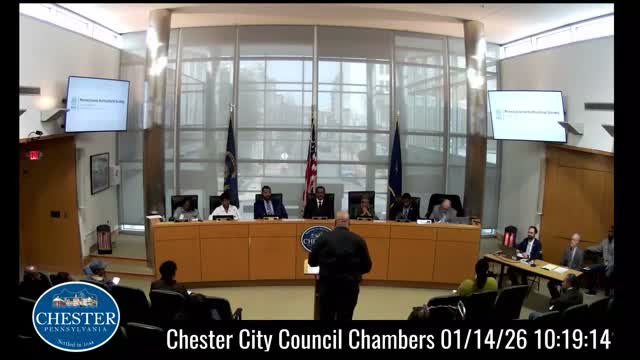
Summary
The Pennsylvania Horticultural Society unveiled a LandCare pilot to clear and green roughly 100,000 square feet of CETA‑owned vacant lots in Chester beginning in March, with twice‑monthly maintenance through summer 2027 and a focus on hiring local contractors. Studies cited by PHS claim reductions in depression and gun violence near treated sites.
The Pennsylvania Horticultural Society (PHS) told Chester City Council it will launch a vacant‑lot cleaning and greening pilot in Chester, stabilizing about 100,000 square feet of CETA‑owned parcels beginning in March.
"This is the first time in PHS's history that our LandCare program is expanding outside of Philadelphia city limits," Melissa Stutzback, director of LandCare, said in the presentation to council. She described an interim treatment of clearing overgrowth, adding topsoil and grass, installing post‑and‑rail fencing and sometimes planting trees to create low‑maintenance green spaces.
PHS vice president Keith Green introduced the program and highlighted local partners who supported the effort, including the Chester Economic Development Authority (CETA) and members of the district attorney's office. Stutzback cited evaluation research: she said randomized trials and studies found reductions in depression and gun violence near treated parcels and a modest property‑value increase, which PHS described as "statistically significant, but not enough to gentrify" nearby homeowners.
Councilors asked how maintenance and use will be handled. Stutzback said current grant funding covers a basic interim treatment and routine upkeep; PHS intends to identify a local maintenance partner and will be on site twice a month from summer 2026 through summer 2027. "We don't have expectations that the community needs to maintain it themselves," she said, adding PHS will encourage neighbors to use the spaces and hopes to contract Chester‑based landscapers and small businesses to do the work.
On parcel selection, Stutzback said PHS prioritized sites owned by CETA to ensure clear authority and long‑term stewardship, plus visible gateway locations and residential blocks where neighbors would see immediate benefits. She warned the treatment is interim: sites can be developed and, if sold, purchasers will be asked to replace the treatment elsewhere in the city.
The presentation closed with an acknowledgement that the pilot is small at first and could expand if sustained funding and community partners are secured. PHS said enhanced programming — community gardens or pollinator plantings — would require additional resources and coordination with CETA.
Council did not take a formal vote on the program during the meeting; staff and PHS agreed to continue community outreach and identify maintenance partners ahead of the March kickoff.