Gilbert staff seek notice of intent for utility rate increases, citing Colorado River cuts and rising costs
Loading...
Summary
Town officials asked the council to publish a notice of intent to increase water and solid-waste rates and begin a 60-day public review, citing Colorado River supply cuts, higher CAP water costs, aging infrastructure including the North Water Treatment Plant reconstruction, rising landfill and vehicle costs, and market volatility for recycling.
Gilbert officials on (presentation date) asked the town council to publish a notice of intent to raise utility rates for water and solid waste and begin a 60-day public review period, citing shrinking Colorado River supplies, sharply higher water costs, aging treatment infrastructure and rising post-collection disposal and vehicle costs.
Town staff emphasized the request is the procedural first step, not a final decision. "What we're asking for tonight is not a final decision," water manager Rebecca Hamill told the council, explaining the notice would set the maximum increases and start the statutorily required notification period ahead of a public hearing and later adoption. Staff said consultants will place preliminary findings and the full rate study on the town website during the review period.
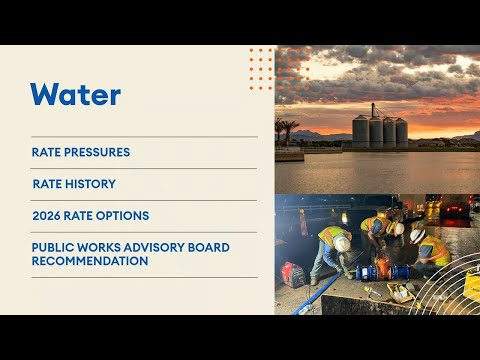
Why the increases: staff laid out three principal pressures on the water fund. Hamill said Colorado River supplies and Central Arizona Project (CAP) costs have climbed sharply in recent years, and that CAP costs have risen roughly 73% since 2020. She said Gilbert depends on Colorado River sources for about 40—2% of its supply and that planned cuts and increased market prices are raising the cost of securing water. "Water is costing more everywhere," Hamill said, adding the town has been pursuing grants and conservation to offset costs.
Infrastructure and operational costs are the second and third major drivers, staff said. Construction and supply inflation has pushed up bids and timelines for major projects; the North Water Treatment Plant reconstruction passed the 50% construction milestone and staff said portions of the facility will come online in the months ahead. "Once it's finished, the North Water Treatment Plant will provide 70% of Gilbert's entire water supply," Hamill said. Rising chemicals, electricity and specialized labor also added to operating expenses.
Solid waste and recycling pressures: Isaiah Garcia Romero, solid waste and recycling manager, said landfill tipping fees and vehicle replacement and maintenance costs are large drivers for solid-waste rate pressure. He said refuse-truck prices rose from about $285,000 before 2020 to more than $525,000 today and that the fleet is aging, with roughly one in three vehicles past the seven-year replacement cycle. Garcia Romero also described swings in recycling commodity markets and two recent major U.S. plastic processor closures that have reduced processing capacity and depressed commodity prices.
What customers would see: staff reviewed two rate approaches for water and a modest revenue increase for solid waste. For solid waste, staff said a 2% revenue increase beginning April 2026 would translate to a 55-cent monthly increase for the town's standard 90-gallon trash and recycling service; commercial customers could see larger examples (staff cited an illustrative 13% base increase). For water, staff presented Option A (a single 25% increase in 2026) and Option E (a phased plan with 14% in 2026 and 14% in 2027, plus smaller later adjustments). The Public Works Advisory Board recommended Option A as the preferred balance between short-term affordability and long-term fund stability.
Consumer protections and assistance: staff stressed that impact fees (for new development) are distinct from monthly rates (which fund operations, maintenance and debt). Hamill cited an ASU Kyle Center affordability benchmark showing Gilbert remains under the 2% affordability threshold for a 4,000-gallon baseline household under both options, and noted the town's bill-assistance program for households up to 120% of area median income.
Transparency measures: the town announced a third-party meter and billing audit to examine more than 90,000 utility accounts. The audit team includes Kimley-Horn and Associates (data and business operations), AMKA Services (infrastructure audit), and M.E. Simpson Company (statistical sample testing); preliminary findings are expected in March 2026 and will be reported directly to council, staff said.
Next steps: staff asked council to publish the notice of intent and begin the 60-day clock for public outreach and the rate study. Staff said they will publish the rate study and undertake a communications plan including online, print and in-person outreach through April 2026; a public hearing in February 2026 will be scheduled during the notification period before any formal adoption is considered.