
Department outlines formula to cap tuition for Workforce Pell programs; negotiators debate data, timing and small‑cohort rules
Get AI-powered insights, summaries, and transcripts
Subscribe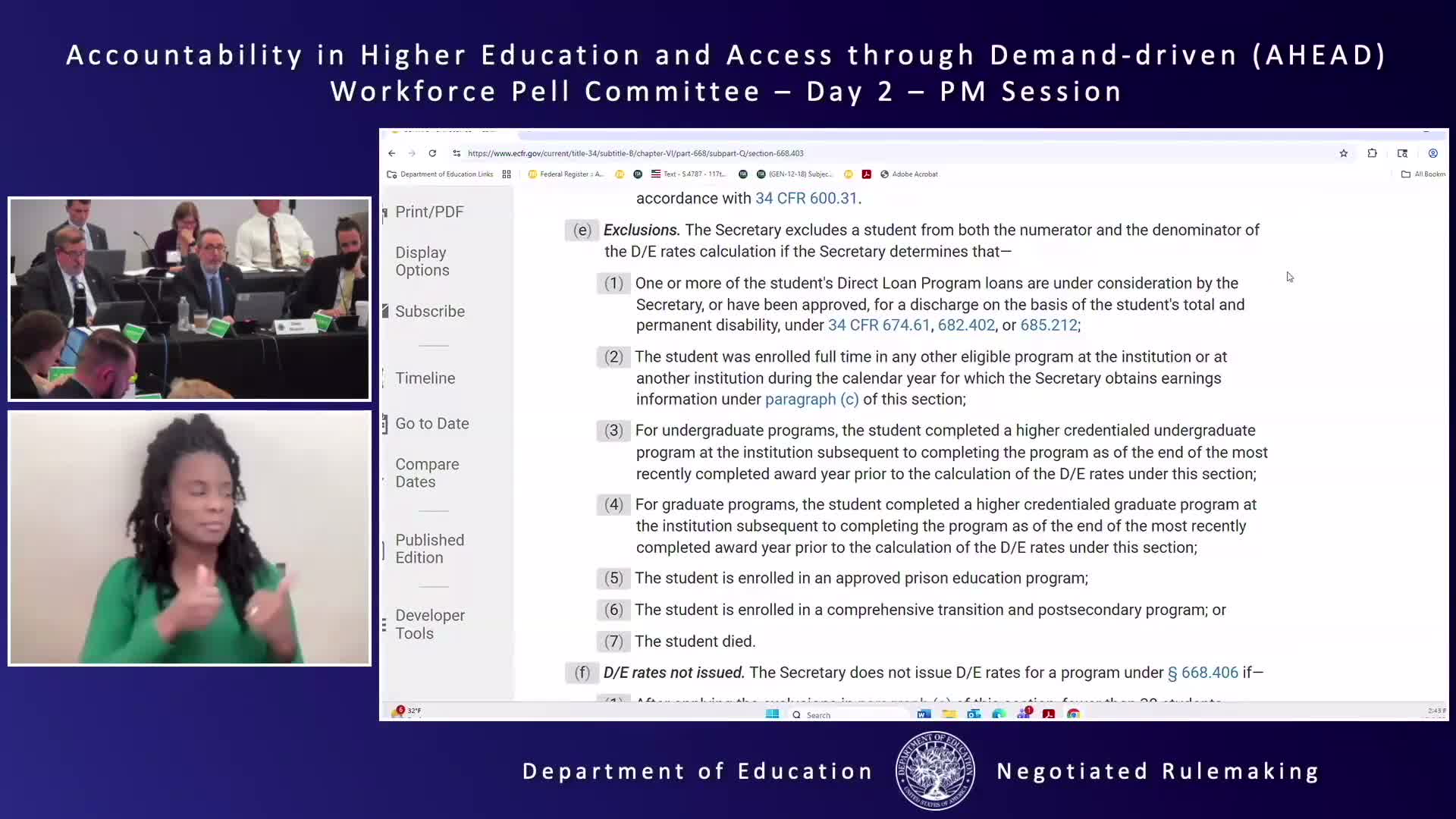
Summary
The Department proposed a value‑added earnings cap (adjusted median earnings minus 150% of the poverty line) to limit Workforce Pell program tuition and described a cohort‑aggregation waterfall with privacy thresholds; negotiators raised concerns about timing, tax‑year alignment, data sources and small programs.
The Department of Education presented a draft method for limiting the published tuition of eligible Workforce Pell programs by calculating ‘‘value‑added earnings’’ and using that figure as a maximum published tuition and fee amount.
Under the Department's proposed formula, an eligible workforce program’s value‑added earnings would equal the program completers’ median annual earnings in the most recent tax year (adjusted using metropolitan‑area regional price parities) minus 150 percent of the poverty line as defined in the Community Service Block Grant Act. Dave said the Department plans to publish the value for each program at least three months before the award year it will govern and that institutions must keep published tuition and fees at or below that value for students who first enroll in the award year after the publication.
The draft contains a privacy‑sensitive matching design. The Department would obtain a list of completers who received Pell from the National Student Loan Data System, send that list to a federal agency with earnings data (the Department cited the IRS as a likely candidate but did not commit), and use the agency’s matched median earnings in the calculation. To address small programs, the Department proposed expanding cohorts backwards by award year until either: (a) the list reaches 50 completers (then send the list), or (b) after rolling back up to four award years, if the list reaches at least 30 completers the Department will attempt to match; even then the federal earnings agency must return earnings for at least 16 students for a value to be calculated—otherwise no value is produced and there is no tuition cap.
Department officials said programs that result in zero or negative value‑added earnings would not be eligible for Pell. They described the value‑added system as ‘‘forward‑looking’’ and intended to limit published tuition so institutions could decide whether a program could operate at the capped rate. "Programs that have a calculated value added earnings of 0 or negative value shall not be eligible for Federal Pell Grant funds," Dave stated during the session.
Negotiators pressed multiple technical issues. Several urged that earnings measurement align to a consistent post‑exit interval so students have a full tax year of earnings to be measured; others noted that using the most recent tax year when the Department publishes values can create ‘‘stub’’ measurement periods that undercount post‑exit earnings. Preston recommended measuring earnings in the first full tax year after a student’s completion. Negotiators also pressed whether the Department could rely on state wage‑record exchanges, Social Security Administration records or other federal data sources, and whether regional price parity and inflation adjustments should be applied consistently across varying cohort rollbacks.
Chance Russell of the Department demonstrated worked examples for hypothetical programs in Arkansas and Alaska to illustrate calculations and the potential tuition caps; in one Arkansas example the calculation produced a $7,122 tuition cap. Negotiators asked that the Department publish proposed values far enough in advance of the award year to allow institutions to update catalogs and notify students.
Ending: The Department acknowledged open issues and said it would take back suggested changes on timing, agency matches, and small‑cohort approaches for further drafting. Negotiators agreed to continue discussion on related eligibility rules the following day.