
Negotiators press Education Department on how governors, cohorts and data will define eligible Workforce Pell programs
Get AI-powered insights, summaries, and transcripts
Subscribe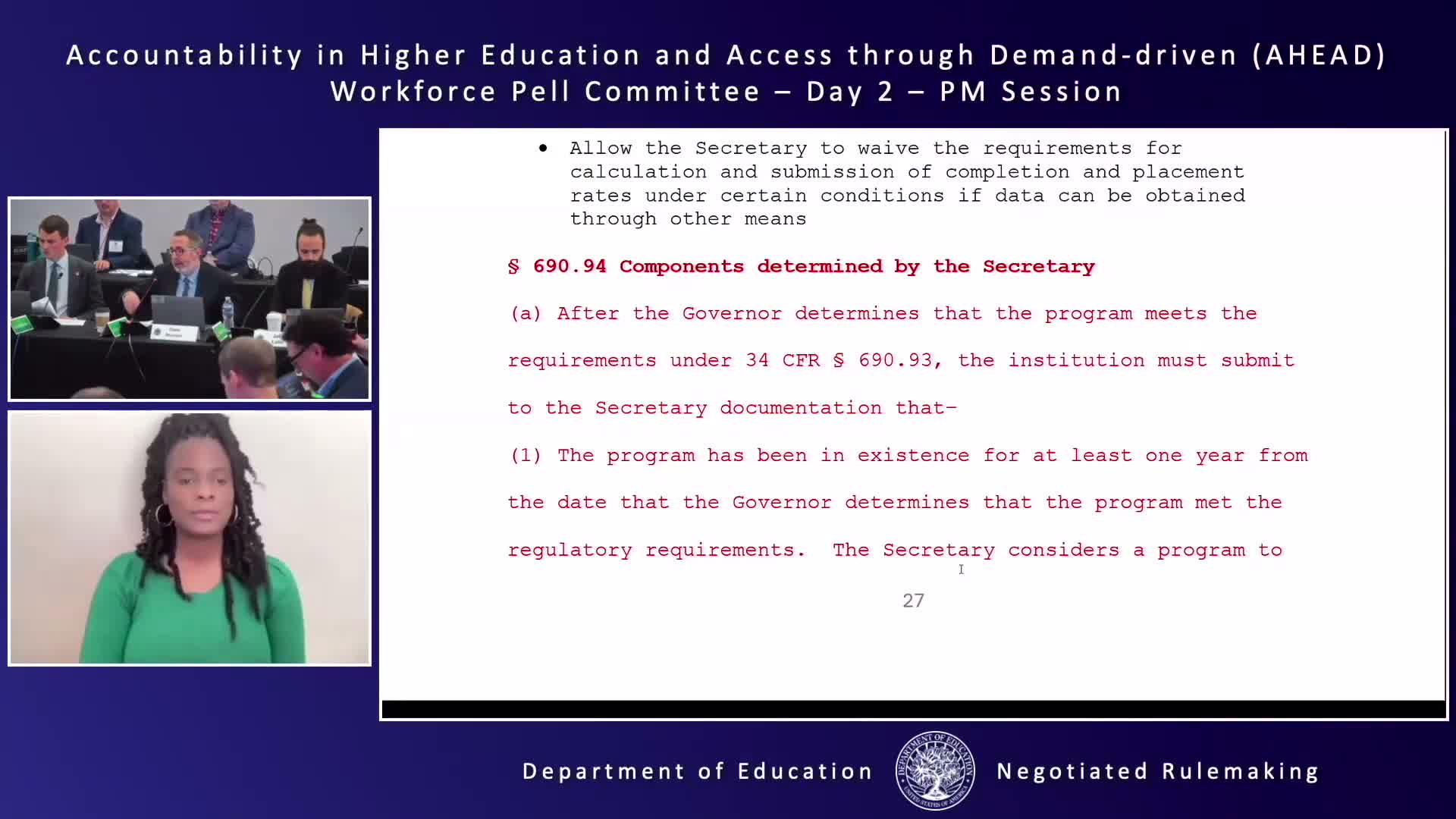
Summary
During a U.S. Department of Education negotiated-rulemaking session, negotiators questioned how the Department will interpret the one-year existence requirement, define cohorts, and calculate 70% completion and placement thresholds; states flagged costs for wage‑record upgrades and asked for exemptions for students entering further education.
Negotiators at a U.S. Department of Education rulemaking session pressed the Department for clarifications on how it will carry out the Secretary’s approval of eligible Workforce Pell programs and how completion and job-placement metrics will be measured.
Dave (Department staff) opened discussion of Topic 5, explaining the draft rule would require a program to have been in existence ‘‘for at least 1 year from the date that the Governor determines that the program met the regulatory requirements’’ under 34 CFR 690.93 and that the Secretary’s approval follows the governor’s certification. He told negotiators the Department intended some flexibility for ‘‘minor changes’’ so long as programs met length requirements (between 150 and 599 clock hours and roughly 8–14 weeks) during the year in question.
Several state and sector negotiators asked for greater precision. Eric, who said he has reported IPEDS data for about a decade, asked whether cohorts would be defined and tracked through an institution’s enrollment list and whether the metric would count ‘‘everyone who enrolled’’ or only those who began attendance. Dave answered that the draft contemplates reporting all students who enrolled and began attendance and that the governor and state analysis would certify the resulting lists for calculation.
On outcomes, the Department proposed two performance thresholds: a completion rate of at least 70 percent within 150 percent of normal time to completion, and a job-placement rate of at least 70 percent—the latter calculated as the share employed in the occupation (or a comparable high-skill, high-wage or in-demand occupation) in the second quarter after exiting the program. Dave said the first two award years (2026–27, 2027–28) would allow a more flexible, transitional standard while later years would apply a more prescriptive calculation.
Negotiators repeatedly warned that the placement measure could unfairly penalize programs intentionally designed to be ‘‘stackable’’ into further education. Aaron and Preston argued that many Workforce Pell programs are meant to lead students into further certificates or degrees, and they urged the Department to exclude students who are enrolled in additional education at the placement-measure date or to remove them from the cohort entirely. Preston said he ‘‘strongly encourage[d]’’ the Department to adopt the same approach used in prior accountability rules that excludes students who remain enrolled in another program from the placement denominator.
States and other attendees also flagged data infrastructure challenges. Randy and other state representatives described substantial costs to expand wage-data systems and noted cross‑border employment creates matching gaps. Department of Labor and Department of Education staff pointed to existing interstate wage‑record exchanges used under WIOA and said the Department was considering those architectures. Dave acknowledged possible federal calculation alternatives (for example, using federal datasets) and said subsection C of the draft gives the Secretary flexibility to use alternate federal data or processes in transition years.
The Department said it intends to be prepared to accept applications July 1, 2026, but cautioned that accreditation, state certification and systems work mean disbursements could take longer. "The Department plans to have a process for accepting applications for Workforce Pell as of 07/01/2026," Dave said, while noting governors and accreditors must complete their steps first.
What happens next: negotiators asked the Department to consider clearer definitions of ‘‘enrolled’’ and ‘‘in existence,’’ to adopt cohort exclusions (including for students who pursue further education), and to provide practical alternatives for states that lack occupation‑level wage data. Department staff said they would take the suggested language back and provide additional guidance during follow-ups and tomorrow’s sessions.
Ending: The session moved on after a scheduled break to Topic 6, value‑added earnings, where negotiators continued to press on data, timing and small‑cohort concerns.