
West Geauga treasurer presents 2026–27 alternate tax budget; board adopts plan amid levy, House Bill uncertainties
Get AI-powered insights, summaries, and transcripts
Subscribe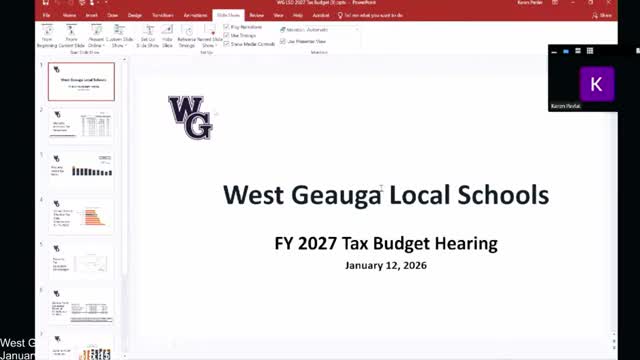
Summary
District treasurer presented an alternate tax budget showing a modest valuation uptick but projected revenue losses from state tax changes; the board adopted the 2026–27 alternate tax budget and was warned the general fund could deplete before 2029 without levy renewals or replacements.
Karen, joining the West Geauga Local School District Board by Zoom, presented the district’s 2026–27 alternate tax budget and financial forecast. She said property valuations rose about $8 million (roughly 0.6%) this year after a larger 2023 revaluation and that the district’s total taxable value is about $1.2 billion. She explained the difference between voted millage and effective tax rate and noted the reinstatement of a previously suspended $2.35 million emergency levy on 2025 tax bills.
Karen told the board the district’s historical collection rate is about 98% but that a 2023 delinquency by a large utility depressed the collection metric. She estimated the 2026–27 revenue forecast at about $39.24 million but warned that two recent state measures — House Bill 186 (inflationary-cap credits) and House Bill 129 — could lower local tax collections by an estimated $1.8 million going forward. Karen said the Department of Taxation must reconcile inconsistencies and will provide more exact figures around April, with a May forecast update planned.
The treasurer also showed a scenario analysis of the general fund balance. Board materials and the presentation noted transfers of roughly $11 million into capital-project funds to address deferred maintenance. With expected levy renewals in question, Karen said the district’s cash position could run short before 2029 under the no-levy-renewal scenario. She emphasized that the board must plan ahead because new levy revenue typically appears 18 months after a successful vote.
After questions about timing, borrowing and the meaning of the district’s debt margin (Karen said a roughly $113 million debt margin at a 9% cap would allow borrowing without special state permission), the board voted to adopt the 2026–27 alternate tax budget as presented and to file required materials with the Geauga County Tax Commission before the county’s filing deadline.
The board requested staff update projections when the Department of Taxation posts final figures in spring and noted that potential levy renewals or replacements will materially affect long-term forecasts.