Homeowner’s 4.26 kW rooftop solar case study: costs, rebates and real-world payback
Loading...
Summary
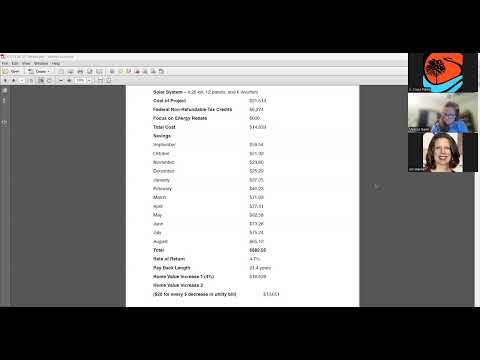
A Village resident presented a one-year case study of a 4.26 kW rooftop system installed in August 2024: installed cost $21,005.13, federal tax credit $6,002.74, Focus on Energy rebate $600, net cost $14,006.39, and first-year savings of $682.55; payback estimates ranged from about 10–21 years depending on assumptions and future electric rates.
A Village resident who installed a 4.26 kilowatt rooftop solar system last August told the Village of Cross Plains Sustainability Committee about the costs, incentives and year-one performance of the system.
The installer’s price for the job was $21,005.13, the presenter said, and he received a federal nonrefundable tax credit of $6,002.74 and a Focus on Energy rebate of $600, reducing his net outlay to $14,006.39. Using a sample Madison Gas & Electric bill for the period 09/10/2025–10/09/2025, the presenter said the system produced 275 kilowatt-hours and produced $682.55 in first-year bill savings.
“Because of the rebates and tax credit, my total cost in dollars was 14,006.39,” the presenter said. “In a year’s time I ended up saving $682.55.”
Committee members and the presenter discussed different ways appraisers might value residential solar. The presenter described two common models: one that applies a flat percentage increase in home value (he cited an example 4% figure) and another that multiplies annual utility savings by a factor (he quoted a $20 multiplier per dollar of annual savings), which produced widely different illustrative numbers for his property.
The presenter noted sizeable variation in month-to-month production: summer months produced a “pretty good return,” while winter months and lengthy snow cover reduced output (one winter month produced only about $17 worth of credit). He also emphasized that without a battery the system remains grid-tied and does not provide power during outages.
Committee members asked about battery systems and complementary uses. One member described adding a battery (a “power wall”) and coupling the solar array with plug-in electric vehicles, saying the combination both saves fuel and provides backup power in outages.
On payback, the presenter calculated a simple payback of roughly 21.4 years under one set of assumptions but said he personally expected a 10–12 year payback if electric rates rise over time. “I am, that’s what I’m thinking,” the presenter said when a committee member suggested the 10–12 year range.
The committee discussed how financing choices change outcomes. The presenter said he paid cash rather than taking a loan and described how a loan at roughly 5.99% interest would alter returns. Members noted warranty terms for panels and typical 20-year loan periods and suggested homeowners weigh financing costs, expected electricity price increases and local production factors.
The committee said the homeowner’s account would be a good case study for public outreach. One member suggested summarizing the presenter’s numbers in a newsletter or other public guidance so residents can better understand costs, incentives and trade-offs.
The committee did not take formal action on the presentation; members agreed to consider using the case study in public education materials.