
Neighbors oppose 112-unit rezoning at 2100 Hard Road; commission declines to recommend to City Council
Get AI-powered insights, summaries, and transcripts
Subscribe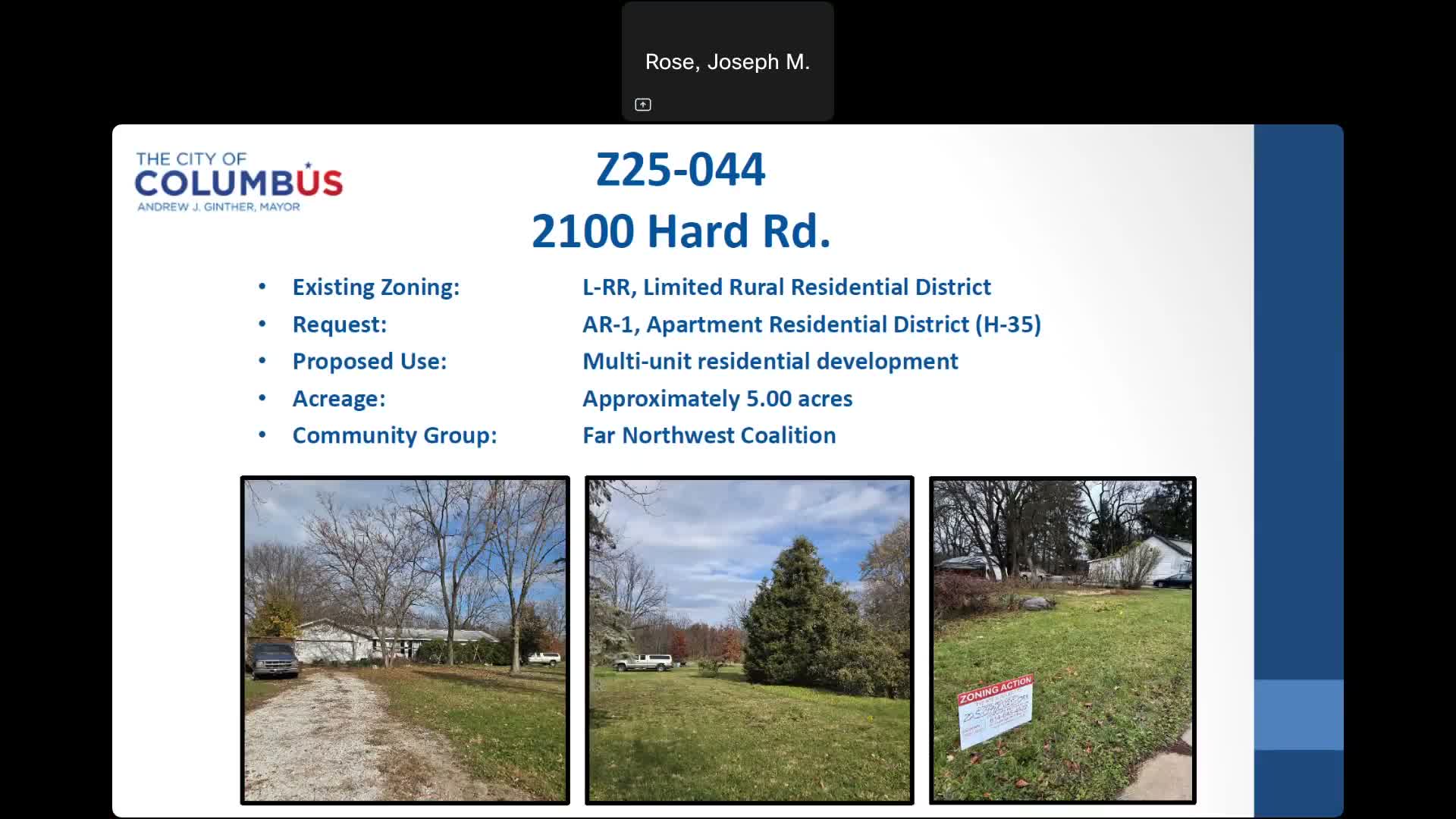
Summary
After extensive public testimony raising traffic, safety, tree‑canopy and tax‑abatement concerns, the Columbus Development Commission voted 5–2 not to forward the rezoning request for 2100 Hard Road (Z25‑044) to City Council with a recommendation.
The Columbus Development Commission on Jan. 8 heard more than an hour of public testimony before deciding not to recommend a proposed rezoning that would allow a 112‑unit apartment complex at 2100 Hard Road.
Residents, neighborhood groups and civic associations told the commission the 5‑acre property is too small for the height and density proposed. John Best, a past president of the Far Northwest Coalition, said the plan’s three‑story buildings would be “very intrusive next to those single family residents” and warned of traffic and wetland concerns. “This is gonna create even more pressures to further widen Smoky Road,” he said.
Deborah Link, speaking for Columbus Northwest neighbors, argued the project would reach “maximum density” and that the proposed 15‑year tax abatement would shift costs onto existing taxpayers. “This tax abatement shifts cost unfairly onto existing Columbus taxpayers,” Link said, and urged commissioners to vote no.
Applicant representatives and the project’s attorney disputed several of the neighbors’ technical claims. David Hodge, attorney for the applicant, said preliminary engineering “doesn’t show” wetland constraints and that the developer will preserve trees where possible and meet any remediation requirements. Jarrett Smith of Preferred Living, the applicant, said the team increased the western perimeter yard to 35 feet and that the project will provide more parking than code requires.
Traffic staff told the commission the proposed 112 units would generate an estimated 58 AM and 69 PM peak trips—below Columbus’s 200‑trip threshold that would mandate a full traffic impact study; staff said it would still review potential off‑site intersection impacts.
Commissioners debated whether the development’s scale and massing fit the nearby single‑family context. Several members urged moving or redesigning Building 5 and adding more landscaping to reduce visual intrusion. After discussion, the commission voted on whether to forward the application to City Council with a recommendation and the roll call produced five no votes and two yeses; the commission therefore did not recommend the rezoning to City Council.
The developer may revise the site plan and return, or present to City Council with or without the commission’s recommendation. The commission’s file will include the recorded votes and public comments submitted with the application.