
Lakota Local board narrows master facilities options, debates May vs. November ballot and funding mix
Get AI-powered insights, summaries, and transcripts
Subscribe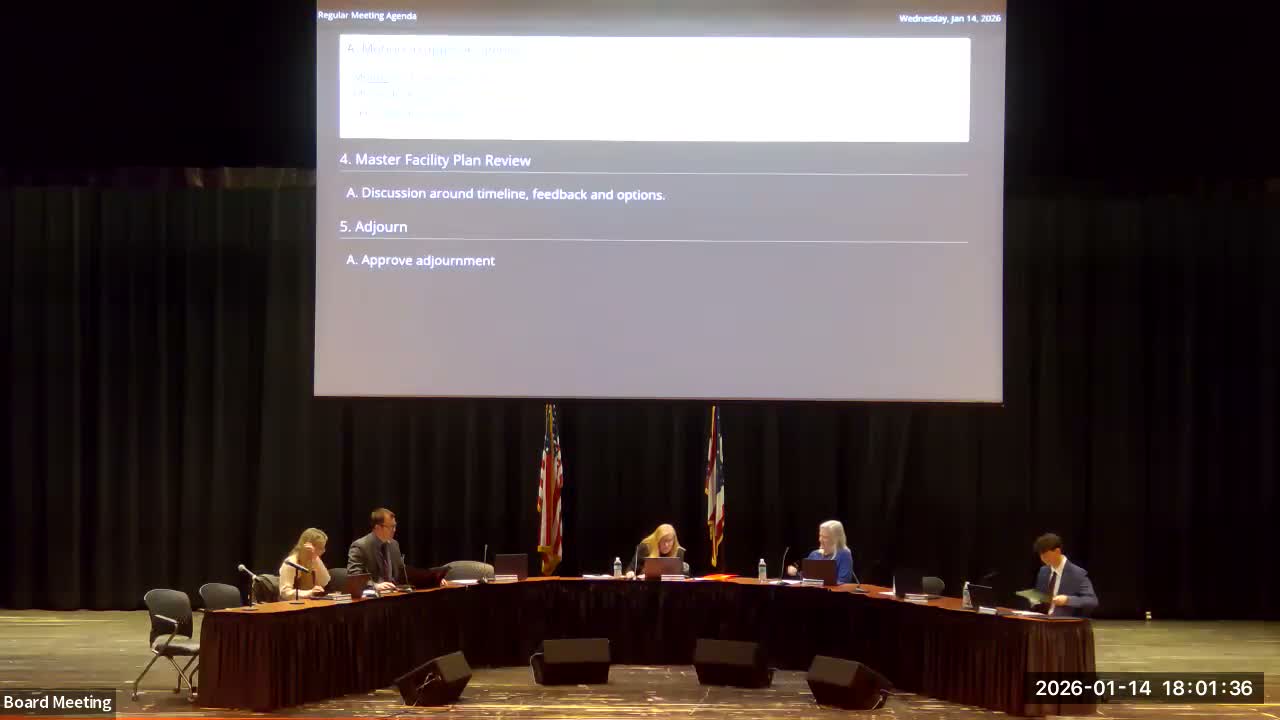
Summary
At a Jan. meeting the Lakota Local Board of Education reviewed two pared-down master facilities options (C1 and D1), heard that the district may be eligible for roughly a 32% state match and that state timing could favor an earlier ballot; members signaled rising support for C1 but split over May versus November and property-tax versus income-tax funding.
Lakota Local School District board members spent a lengthy meeting reviewing two streamlined versions of a proposed master facilities plan — labeled C1 and D1 — and debating whether to seek voter approval in May or November 2026. Staff and outside advisers told the board the district could be eligible for a roughly 32% state funding match and that the district’s place “on the bubble” for state dollars could come as early as July 2026.
Why it matters: The board is weighing a package that officials say has been substantially reduced from prior planning (from about $506 million in earlier iterations to roughly $289 million in the current draft) while still aiming to manage projected enrollment growth of about 2,000 students by 2033. The timing and funding mechanism will determine how quickly construction can begin and which taxpayers bear the cost.
The options and their trade-offs District staff described C1 as a model that creates two new junior-high (middle) schools and D1 as a model with four middle schools; both approaches were built from community priorities including flexible learning spaces, revised grade bands, attention to K–6 class size and improved safety and security. Staff emphasized the importance of designing any new buildings for future adaptability — for example, so a middle-school structure could be converted to elementary use later if needed.
Tom Fernandez, the district’s architect, told the board that post-election outreach included 12 listening sessions and a survey with about 1,000 respondents and that design choices tried to respond to community concern about demolishing buildings and to give options that deliver broad, districtwide benefits. Fernandez said officials had accounted for projected square footage needs so the plans can accommodate anticipated enrollment growth and that designing new buildings for conversion preserves future flexibility.
Timing and state funding Jens, the board’s political/timing adviser, told trustees “timing is everything,” contrasting the trade-offs between a May primary ballot (lower turnout but a more civically engaged, tax-sensitive electorate) and a November general election (larger turnout but a crowded, partisan information environment). He also warned of an active citizen effort to place a constitutional amendment on the November ballot that could materially change property-tax rules statewide, creating added uncertainty for November financing.
Finance staff member Adam summarized timing for debt issuance: certification and preparation typically take three to six months after a successful vote, then the district can sell bonds and receive proceeds; income-tax-based structures, by contrast, change cash-flow timing and often require different debt instruments and longer stabilization of collections.
“If we go on in May and we’re successful, you’re able to sell the bond in August,” Adam said, summarizing the general timetable for a property-tax-backed bond sale. “It would take anywhere from three to six months to get everything in order — prepped out — and then go to the bond sale.”
Costs, capacity and community concerns Board members repeatedly raised concerns about cost and community trust. Several members said the current drafts respond to feedback by scaling back from the previously larger plan; one trustee noted the district is overcapacity by about 750 students now and faces further growth, making planning urgency a factor.
Board views and next steps By the end of the discussion a majority of trustees signaled growing alignment around option C1 (two junior highs) while several said they could live with D1 if design flexibility were preserved. Trustees remained split on timing: some favored a May placement to avoid competing statewide races and to capitalize on a potential state match that might materialize sooner; others urged waiting until November to allow more time for community education and a calmer reception after recent defeats.
Several trustees asked staff to prepare comparative financial slides and polling/test questions for community outreach ahead of the next formal discussion. Staff recommended, and trustees discussed, placing a nonbinding resolution of intent on the Jan. 20 agenda if the board wants to preserve the flexibility of filing deadlines while still being able to stop the process later if conditions change.
No ballot measure was authorized at the meeting. The board voted to adjourn after directing staff to provide more financial detail and to consult with the absent member before any formal resolutions to place the question on a ballot are scheduled.
What’s next: Staff will prepare data (millage comparisons, amortization scenarios and outreach/polling options) for the next board meeting on Jan. 20; the board discussed possibly approving a resolution of intent at that meeting to hold options open subject to later confirmation.