Get Full Government Meeting Transcripts, Videos, & Alerts Forever!
Get email alerts on the Neighborhood Planning topic
No spam. Unsubscribe anytime.
Burbank study session: Rancho plan centers equestrian safety; draft historic district ruled out
Summary
City staff updated the council on the Rancho Neighborhood Specific Plan, emphasizing equestrian safety, outreach results and data gaps, and reporting that the neighborhood as a whole does not meet National Register criteria for a historic district; staff said draft technical reports and the EIR are expected late 2026–early 2027.
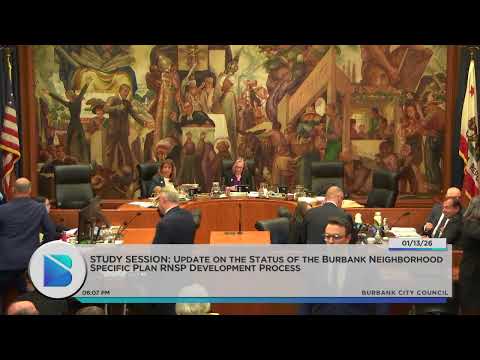
Burbank city staff presented a status update on Jan. 13 for the Rancho Neighborhood Specific Plan (RNSP), saying safety for horses and riders will be the guiding policy principle as the project moves into alternatives and detailed design.
"Safety, specifically equine safety, stands out as one of the major and primary concerns related to mobility in the Rancho," said Greg Mirza Vakian, senior planner with the Community Development Department, describing findings from counts, site visits and expert interviews.
The project area covers about 315 acres in southwest Burbank and includes roughly 3,800 residents and 1,450 housing units, staff said. The presentation summarized outreach dating to 2020, a project website launched in April 2025, and two public events (a May 10, 2025 self-guided route that drew 115 sign-ins and an Aug. 2, 2025 pop-up that attracted about 70 participants). About 250 people were on the project mailing list as of December 2025.
Staff presented equestrian and mobility data and cautioned about underreporting: records show 132 properties with some equestrian activity since 2006 and a historical peak of 171 horses, while 24 properties now show active registrations for 30 horses. A 2025 snapshot recorded 30 registered horses and 23 properties with manure-pickup requests; staff said the true numbers are likely higher due to gaps in the records.
Dudek's subconsultant prepared a draft historic context statement and a reconnaissance survey of 911 properties. "The draft statement concludes that Burbank Rancho does not meet the criteria for historic district designation," Mirza Vakian said, noting that although the neighborhood has meaningful equestrian history, loss of stables and alterations to properties limit district-level integrity. Staff added that individual properties might still qualify for historic designation.
Mobility findings showed equestrian and bicycle activity concentrated near the LA Equestrian Center and the Mariposa Street Bridge; staff noted the bridge (built 1939) is listed on the National Register of Historic Places and serves as the only equestrian crossing over the L.A. River. The team identified seven intersections with equestrian crosswalk buttons and recommended equestrian-specific crossing infrastructure such as signs and push-button-activated flashing beacons where appropriate.
Council members pressed staff on methods and timing. Mirza Vakian said counts included morning and evening weekday periods (morning counts roughly 7:00–10:10 a.m., evening counts about 4:30–7:30 p.m.) and that equestrian weekend counts were used because weekend activity was higher; consultants recommended additional weekend studies when school is in session to capture typical peaks.
On permitting, staff explained that owners must have a legal horsekeeping facility to register a horse: "The permit is to register a horse at your property and that [registration] is contingent upon having a legal horsekeeping facility," Mirza Vakian said. He noted many structures are older and lack clear records, which complicates registration and contributes to undercounting. Council members asked staff to explore ways to make it easier for longtime residents to legalize existing barns without triggering full modernization requirements.
Council members also raised code conflicts with accessory dwelling units (ADUs). Staff said the current code gives precedence to residential uses, which can render existing horse facilities nonconforming if a residential occupancy is added nearby; the city attorney and staff said they will review options and present alternatives, including buffers or grandfathering, for council consideration.
Vice Mayor Mullins requested that staff respond to detailed resident emails and consider expedited work on permitting and animal-regulation updates so some fixes do not wait until plan adoption. Mirza Vakian said technical reports (historic context, mobility analyses) will be released with the draft environmental impact report (EIR), currently estimated for late 2026 or early 2027, and the specific plan adoption is tentatively targeted for 2027.
Staff emphasized that phase 1 (discovery and analysis) is complete and that phase 2 will present alternatives to the public later this year; the council will have further opportunities to review options and direct policy choices. The project team said it will return with more detailed alternatives and cost/implementation information once community feedback on phase 2 is collected.
The study session concluded with council praise for community outreach and a short recess.