
City engineer outlines five‑year pavement plan as backlog and repair costs climb
Get AI-powered insights, summaries, and transcripts
Subscribe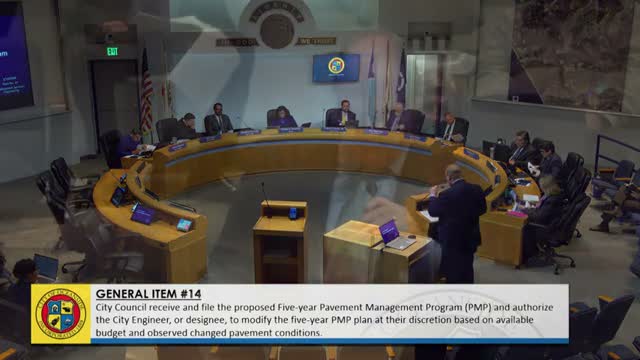
Summary
City Engineer Brian Thomas presented the five‑year Pavement Management Program: Oceanside’s PCI is 61 with a 22.5% backlog; staff recommended receive and file the plan and flexible annual adjustments by the city engineer to respond to funding and observed conditions.
Brian Thomas, Oceanside city engineer, presented the city’s five‑year Pavement Management Program (PMP), describing the extent of paved surfaces (about 490 centerline miles and ~90 million square feet), the 2023 pavement condition index (PCI) of 61, and a backlog—streets rated poor to very poor—of about 22.5% (national average 12%). Thomas explained the hierarchy of treatments (slurry seal for PCI≥70, mill & overlay for PCI 40–70, and full‑depth reconstruction for PCI<40) and warned that deferred maintenance increases the cost and depth of future repairs.
The presentation included recent spending ($42 million over five years) and projected available funding of about $51.1 million for the next five years (roughly $10.2 million per year). Staff said maintaining the city’s current PCI would require roughly $11.2 million per year and reducing the backlog would require approximately $14.9 million per year. The plan prioritizes arterial roadways for the next two years and allows the city engineer, in coordination with the city manager, to adjust the five‑year plan based on funding and observed pavement conditions.
A public speaker raised the related issue of sidewalk replacement quality and asked how such sidewalk issues are routed through city departments; staff replied that the downtown workshop will include unified standards and that public works handles pothole reporting through the city’s service request system and customer care line.