
Rialto council pauses vote on proposed water, wastewater rate increases; seeks fuller CIP and accounting of prior repayments
Get AI-powered insights, summaries, and transcripts
Sign Up Free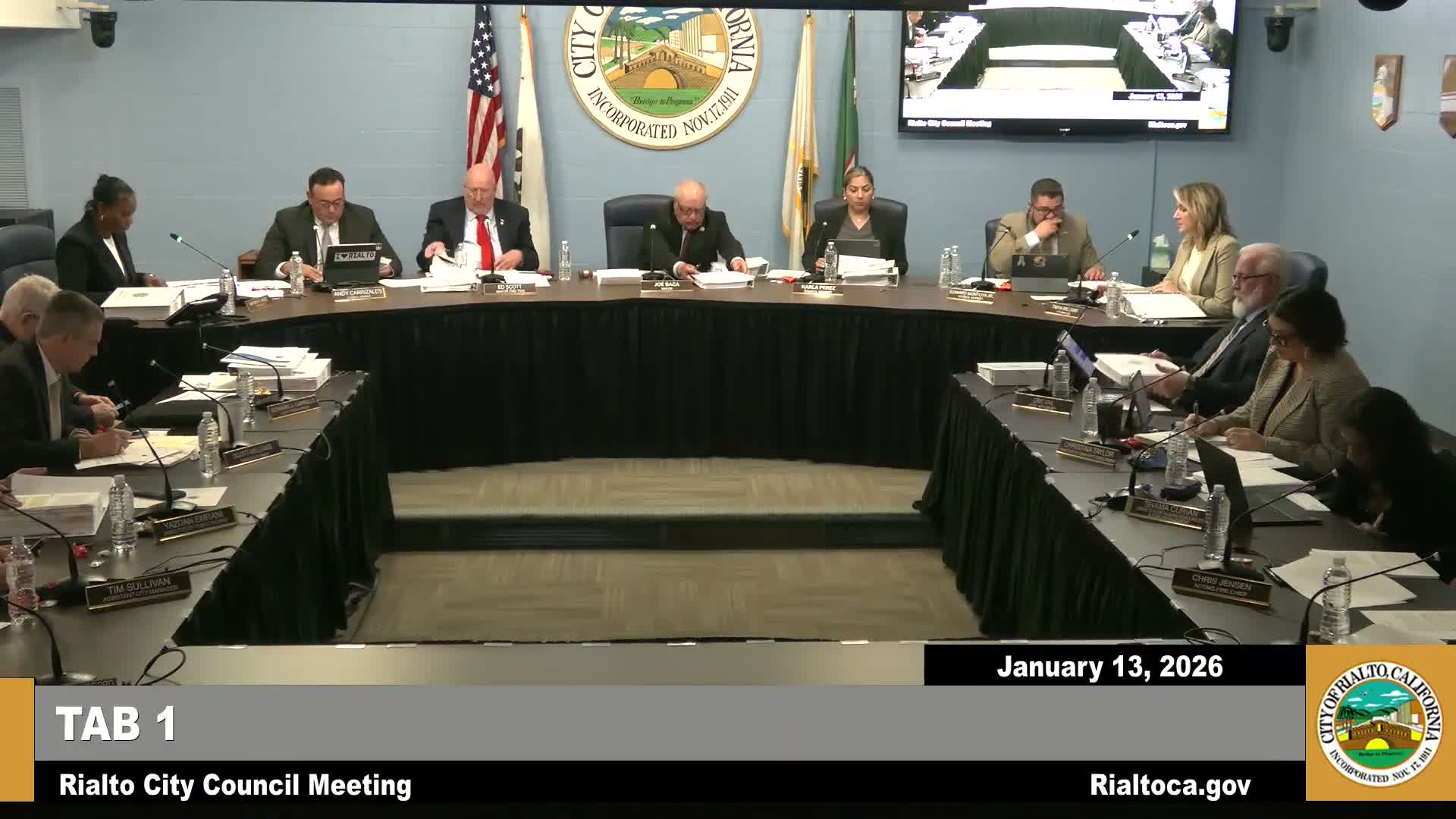
Summary
After a lengthy presentation on a proposed water and wastewater rate schedule, the council voted to continue the item for two weeks, citing missing CIP approvals and unanswered questions about previously repaid utility funds. Consultant Sanjay Gaur outlined a proposed 23% first-year water revenue increase and multi-year wastewater adjustments.
The Rialto City Council on Monday held a Prop 218 public hearing on proposed adjustments to water and wastewater rates and voted to continue the item for two weeks to allow staff to provide a fuller capital improvement plan (CIP) and supplemental materials.
Consultant Sanjay Gaur of Water Resource Economics presented the study and financial plan, telling the council the proposal would generate a 23% revenue increase for water in 2026 and then phased smaller adjustments in following years. "If city council does adopt these rates, they will be effective March 1," Gaur said. He described a $32.7 million water CIP plan (with $10 million funded by rates, $3.5 million from a rate-stabilization fund, $14.5 million in grants and $4 million in developer fees) and a wastewater CIP approach that relies more heavily on reserves and a proposed $6 million debt issuance to smooth increases.
The council pressed staff on multiple points, including whether the full CIP had been approved by the full council and how previously returned funds were used. Mayor Pro Tem Scott said he believed some briefings had not been shared with all members and challenged the presentation language that said the water subcommittee "provided direction." Council members also asked for a clearer accounting of a prior $35 million repayment to the utilities: "When we voted to give that money back ... the direction was that the money was to be used for rate stabilization," said Councilmember Scott, adding, "it doesn't appear that the $35,000,000 did much to stabilize rates." (Councilmember Scott used the term "stabilize" during questioning.)
City Attorney's office summarized the objection process: the city received nine written statements of objection and seven were filed under AB 2257 but did not qualify as Prop 218 protests. "We've only received 9 statements of objection," the city attorney noted, and staff said the count falls well short of a majority-protest threshold that would block adoption under Prop 218.
Several council members said they had not received all charts and backup materials shown in the presentation and requested individual briefings. After discussion, a motion to continue the item for two weeks was made and seconded; the motion carried. Council directed staff and consultants to provide missing charts, a clearer CIP that has been considered or approved by the full council, and a breakdown showing how rate-stabilization and previously repaid funds were allocated.
Next steps: The council will reconvene the public-hearing item at a date-certain meeting in two weeks with additional documentation and an updated presentation. The item remains open for public comments and formal action at the continued hearing.