ComEd outlines enclosed Gooding Grove substation upgrade in Homer Glen; trustees question height, transparency and neighborhood impacts

Homer Glen Board of Trustees · January 15, 2026

Get AI-powered insights, summaries, and transcripts

Subscribe
AI-Generated Content: All content on this page was generated by AI to highlight key points from the meeting. For complete details and context, we recommend watching the full video. so we can fix them.

Summary

ComEd briefed the Homer Glen Board of Trustees on plans to enclose and modernize the Gooding Grove Substation at 13015 W. 143rd St., citing equipment age and system reliability needs. Trustees pressed the utility on building height, access to interior plans, potential noise and EMF impacts, parking and construction impacts; ComEd said the design minimizes footprint and that the work was vetted through PJM’s M3 process.

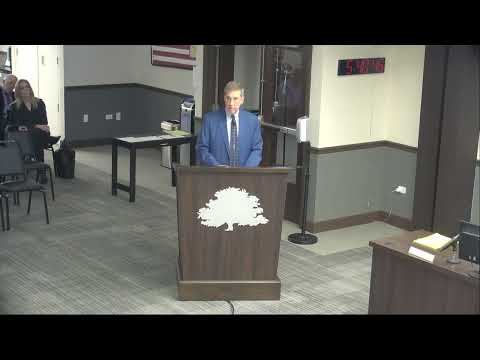
ComEd representatives presented plans to modernize the Gooding Grove Substation at 13015 West 143rd Street during a Homer Glen Board of Trustees meeting, saying the project will enclose aging equipment, update breaker systems and improve regional reliability.

"We continue to provide advancements to infrastructure technology and system hardening," Lisa Bridal, ComEd external affairs, told the board as the company described the project’s goals and the team that will follow through on design and construction. ComEd counsel said the substation handles 345-kilovolt and 138-kilovolt lines and that the project was reviewed through PJM’s M3 process and incorporated into PJM’s regional transmission expansion plan in November 2024.

Why enclosure and why the height? ComEd said enclosing equipment reduces outdoor footprint and protects sensitive transmission equipment; it also allows more efficient future capacity increases without adding additional substation land. The company described moving from a linear breaker system to a modern networked breaker system to reduce the risk that a single failure would take multiple transmission lines offline. ComEd noted the enclosure must provide an internal crane and clearance to lift and move large, modular equipment during installation and maintenance; specific height figures discussed by the presenters included 58 feet, 49 feet and a technical measurement near 51 feet depending on grade and the point of measurement.

Trustee concerns focused on visual impact, transparency and community effects. Trustees and residents asked why the building is so tall for what some called a single-story operational facility, pressed for full interior architectural plans before permitting decisions, and raised questions about perceived noise and EMF exposure for nearby neighborhoods, including Founders Circle and Martin Gale. Trustee Schaller said of the planned enclosure: "It is an eyesore," summarizing a frequently voiced neighborhood concern about visibility and scale.

ComEd responded to technical and operational questions. The utility said it is not adding new transmission service to the site as part of this project and described the work as replacing and consolidating existing equipment. On outages, ComEd told the board there are no planned power outages to village customers during phasing and connection work. On parking and ADA requirements, ComEd said substations are typically unpaved to preserve grounding-grid dissipation and that safe, dust-free staging areas are available on-site rather than a conventional paved lot.

The company also showed precedent designs from other Chicago-area substations and said this project includes brick veneer and other architectural elements intended to reduce visual impact and better match community character.

What happens next: ComEd and village staff said more detailed architectural drawings exist and may be provided to the board after resolving legal and confidentiality issues. The project will proceed through the village’s Planned Unit Development (PUD) review and a planning commission public hearing; the board scheduled additional local discussion at its next regular meeting.

The trustees did not vote on the project during this session; the meeting concluded with a motion to adjourn and a pledge to continue the conversation at a subsequent meeting.