Get Full Government Meeting Transcripts, Videos, & Alerts Forever!
Get email alerts on the Workplace Safety topic
No spam. Unsubscribe anytime.
House Judiciary Hearing Spotlighted Acute Silicosis Risk in Artificial-stone Fabrication; Speaker 1 Accuses Colleagues of Seeking Liability Protections for Some
Summary
At a House Judiciary Committee hearing, Speaker 1 described acute silicosis as a lethal occupational disease affecting artificial-stone fabricators and accused some colleagues of pushing to shield manufacturers from liability rather than protect workers; no formal motions were recorded in these remarks.
Speaker 1 told the House Judiciary Committee that acute silicosis is a severe occupational disease afflicting workers who fabricate artificial stone and that courts are beginning to hold manufacturers accountable. "Acute silicosis is a disease that renders your lungs useless," Speaker 1 said, adding that patients can "struggle to breathe as fluid fills your lungs up, cutting off your oxygen supply."
The speaker outlined the human and financial cost of the illness as presented at the hearing: he said there is no cure, and quoted a double-lung transplant cost as "1000000 dollar" while noting that even transplant recipients typically gain only a few additional years of life. The speaker attributed to medical experts the view that the only fully safe approaches are wearing a full hazardous-material suit or shifting to machine-only fabrication, which he said are not yet technically or economically feasible.
Speaker 1 described how artificial stone differs from natural stone: he said nanoparticles produced during fabrication are so small and numerous they can escape respirators and protections designed for natural-stone work. "They're so small and so plentiful in artificial stone that they can escape any respirator," he said. These statements were presented to the committee as the speaker's account of medical and technical assessments discussed at the hearing.
Turning to policy and politics, Speaker 1 said colleagues were not focused on protecting workers but on shielding industry. He accused some colleagues of seeking to "immunize the big...manufacturers" — as he put it — from being held accountable in U.S. courts, and characterized the protected parties as "primarily foreign owned" and tied to a "Trump mega-donor." The speaker asked to be corrected if his understanding was wrong; the transcript contains no response or rebuttal in this segment.
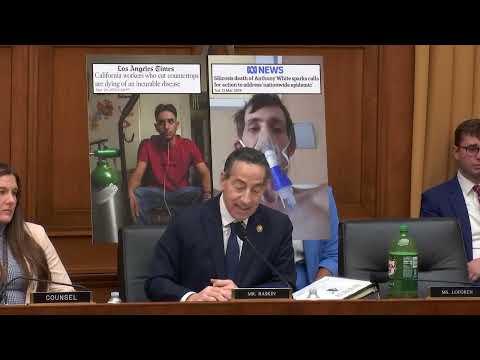
The speaker cited recent litigation and media coverage as part of his context, referencing California lawsuits and headlines reporting that countertop workers have been diagnosed with the disease. He also said other countries had taken different approaches, asking rhetorically whether anyone advocated a ban ("That's what they did in Australia as an inherently dangerous substance") or prosecutions ("Spain did in 2023") — phrasing he used to contrast those options with what he portrayed as his colleagues' aims. Those international references are presented as the speaker's characterizations.
No formal motions, votes, or staff directives appear in this portion of the hearing. The remarks ended with partisan framing that invoked former President Donald Trump and J.D. Vance and concluded with Speaker 1 yielding back to the chair.
Next steps were not specified in the transcript excerpt provided; the record here covers a single extended statement and does not document committee action, additional witness testimony in this segment, or responses to the accusations recorded above.