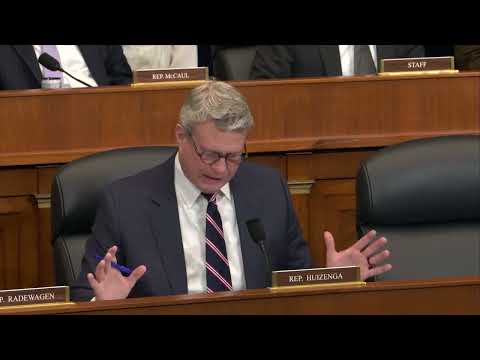
Unidentified speakers at hearing debate export controls, advanced AI chips and the STRIDE Act
Get AI-powered insights, summaries, and transcripts
SubscribeSummary
Unidentified speakers at a committee hearing debated whether the U.S. should sell advanced AI chips to China, cited a claimed post-export-control '5x advantage,' and discussed the proposed 'STRIDE Act' and use of the foreign direct product rule; no motions or votes were recorded.
Unidentified Speaker 1 (unidentified speaker) said the United States hosts major AI infrastructure, naming 'Colossus' data centers associated with Elon Musk and describing them as "crown jewels" of American AI capability. Speaker 1 asked what military, intelligence and economic capabilities China could unlock if it developed equivalent centers, and referenced a previously stated large-chip figure that is unclear in the transcript.
Unidentified Speaker 2 (unidentified speaker) replied that two separate capacities matter: the ability to train more powerful models and the ability to run them in production. Speaker 2 said the U.S. was "roughly at parity" with China before recent export controls and asserted that "we now have a 5 x advantage" in the share of the most advanced computational power after those controls.
Unidentified Speaker 3 (unidentified speaker) rejected proposals to sell advanced chips to China. In a brief exchange, Speaker 3 said, "Absolutely not," and argued that Chinese leadership would limit purchases, require domestic firms such as Huawei to rely on inferior chips for a period, and ultimately try to oust foreign competitors such as NVIDIA. Speaker 3 called the idea that selling chips would "addict China to our technology" a "fairy tale."
Speaker 1 introduced a named legislative proposal, describing the "Semiconductor Technology Resilience, Integrity, and Defense Enhancement Act (STRIDE Act)" and asked whether the United States should apply the foreign direct product rule to prevent "foreign back filling"—that is, repairs, enhancements or other pathways that would defeat export controls. Speaker 2 said the U.S. should aim for an agreement allies can accept but should keep enforcement tools available if necessary.
The transcript records discussion and technical framing of national advantage, export control tools, and legislation discussion but does not record any formal motions, votes, or committee actions. Several quantitative statements in the exchange are imprecise in the transcript (for example, a chip-count number in SEG 003 is garbled and not specified); the article does not treat those figures as established facts.
The hearing closed with no recorded decision on legislation in the provided transcript. The speakers identified policy options: tighter export enforcement (including the foreign direct product rule) and allied cooperation on controls, and rejected proposals to actively sell advanced chips to Chinese firms as a strategy to halt domestic Chinese development.