
Auditors give Oxford Area SD clean opinion on 2024–25 finances; pension liability still large
Get AI-powered insights, summaries, and transcripts
Subscribe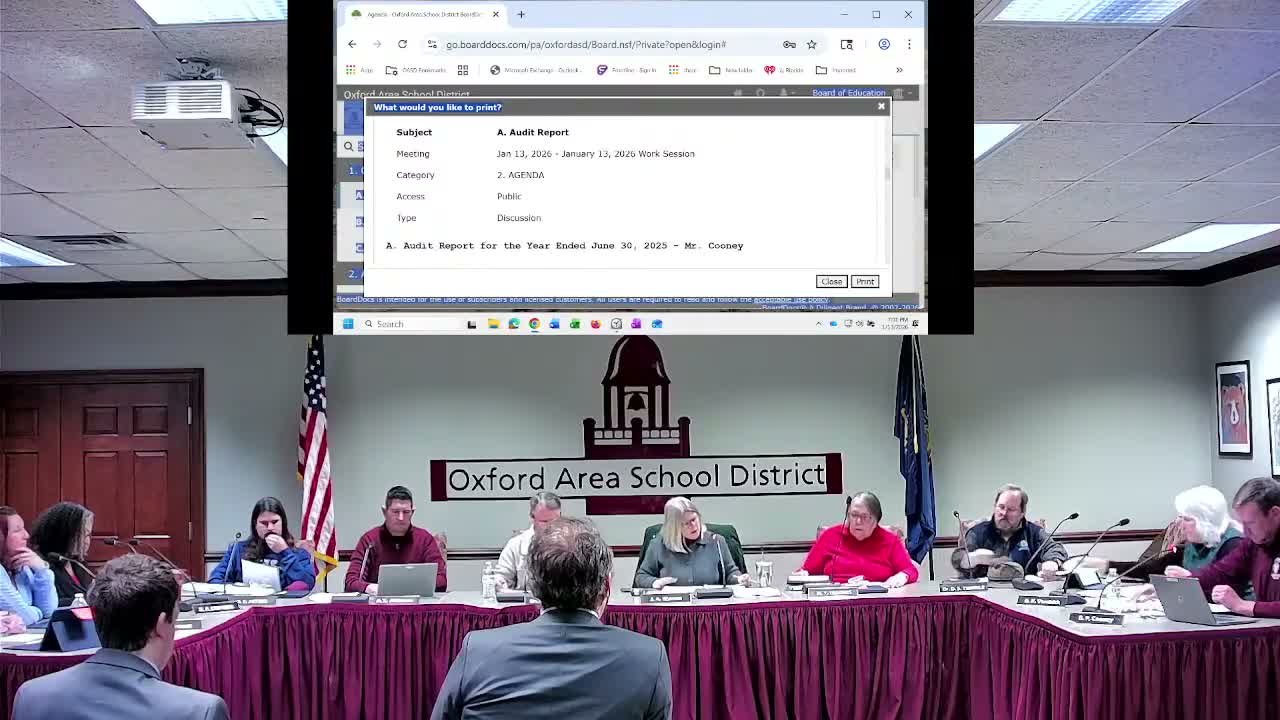
Summary
Independent auditors presented unmodified (clean) opinions on Oxford Area School District’s 2024–25 financial statements and federal single audit, reporting no control findings; they noted a net deficit driven largely by the district’s share of pension liabilities and said the district’s general fund performed slightly better than budgeted.
Independent auditors told the Oxford Area School District board on Jan. 13 that they will issue unmodified — commonly called clean — opinions on both the district’s financial statements for the year ended June 30, 2025, and on compliance for major federal programs.
Jeff Kowalczyk, who introduced the report for the audit team, said auditors tested internal controls and transactions during a fall field visit and performed a federal single audit because the district expends more than $750,000 in federal funds. "We are issuing unmodified, also known as clean opinions, both on the financial statements as well as on compliance with the major federal programs," Kowalczyk said. He said the federal testing covered Title I and the child nutrition cluster.
The report shows the district records a net deficit of $11,400,000 on an entity‑wide basis, primarily because of its proportionate share of the state pension plan net liability. Kowalczyk said that liability is about $62,000,000 for the district, down from $71,000,000 the prior year, and attributed the improvement to multi‑year rate increases and plan design changes that began reducing the long‑term obligation.
At the fund (budgetary) level — the basis most familiar to the board for operating decisions — the district had expected to use about $3 million of fund balance to balance the general fund but instead saw a decrease of about $2.2 million, roughly $1 million better than originally budgeted. Kowalczyk said combined ending fund balances across funds were about $15 million, of which roughly $1.5 million was unassigned and available for general use; much of the rest was committed or assigned for longer‑term purposes and capital work.
Kowalczyk also described the food service fund’s turnaround: the fund produced a positive result of about $800,000 this year compared with a loss in the prior year, helped in part by a transfer from the general fund. He noted a new accounting standard changed reporting for compensated absences (sick and vacation time), requiring recognition of the portion expected to be used before separation at current pay rates; that change is applied retrospectively on an entity‑wide basis and does not affect budgetary results.
On internal controls, Kowalczyk said auditors "did not identify any weaknesses, deficiencies, or other matters to bring to this board," praising staff cooperation and existing policies. He thanked district staff by name in the presentation, referring to "Brian and his team" and "David and his team" for their assistance during the audit.
The board chair confirmed the audit report will be placed on next week’s meeting agenda for formal acceptance. Several board members were encouraged to review the full report in advance; auditors advised that the Management’s Discussion and Analysis section is unaudited narrative intended to provide context but is not subject to an auditor’s opinion.
Procedure and next steps: the administration recommended that several separate tax‑relief requests be reviewed by the finance committee in February rather than rushed onto the Jan. 20 agenda so members have time to digest materials and the committee can issue a recommendation to the full board.
No votes on the audit were recorded in the transcript; the chair requested a motion to adjourn and the meeting was motioned and seconded at the close of the session.