MAG study recommends new interchanges, access-management plan for Grand Avenue–Loop 303; residents say ADOT failed to notify
Loading...
Summary
The Maricopa Association of Governments presented a US 60/Grand Avenue–Loop 303 corridor study recommending short-term fixes, a new interchange (155th/155th-area) and major upgrades to reduce expected 2050 congestion; Sun City West residents at the meeting criticized ADOT’s notification and asked for mitigation details.
Sun City West — The Maricopa Association of Governments (MAG) on Thursday presented a regional study that maps transportation improvements for Grand Avenue (U.S. 60) and Loop 303 through 2050 and recommends short-term fixes, a new interchange east of the current Grand Avenue–303 crossing and major upgrades to the existing interchange.
Brad Williams, special projects coordinator for MAG, told several dozen residents at Sun City West that the study’s purpose is "identify where transportation improvements are going to be needed between now and the year 2050, and when are they going to be needed." He said MAG included planned development from member jurisdictions and freight operators in its forecasts.
MAG said the study area now has about 50,000 residents, expects roughly another 50,000 by 2030, and — in the presentation’s wording — will be "close to a quarter of 1000000 people" by 2050. Williams warned that growth has already driven serious congestion at the 303–Grand Avenue interchange and nearby 163rd Avenue, with the presentation citing peak backups of about 20 minutes to merge onto the 303.
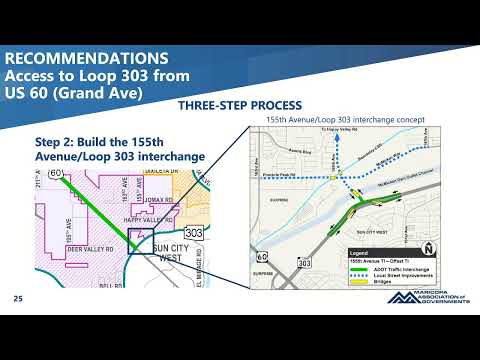
To address the problem MAG proposed a three-step approach: accelerate small, near-term capacity measures (turn lanes and signal work); design and build a new interchange roughly one mile east of the Grand Avenue interchange (design work already under way); and carry out major upgrades to the existing Grand Avenue–303 interchange and adjacent segments. Williams said short-term construction is nearly complete and that design on the Hundred and 55th (155th) interchange is moving fast, with construction targeted to begin in 2028 pending environmental review and the project optimistically expected to open to traffic by 2030 if schedules and funding hold.
MAG stressed design constraints at the proposed new interchange, saying high-voltage power lines paralleling the freeway require some ramps to remain at grade and be consolidated on the north side of the corridor. The presentation described interchange concepts planned to reduce weaving — including a diverging-diamond configuration for the main 303–Grand Avenue crossing and a single-point urban interchange for elevated turning movements — to keep mainline Grand Avenue traffic separated from turning movements.
Williams also urged local jurisdictions to adopt an access management plan because, he said, while ADOT can prepare an access management plan for state highways, "by law, they're not allowed to enforce it" and the State Transportation Board historically has not approved such plans; local cities and Maricopa County would have enforcement authority over local connections.
Residents at the meeting raised concerns about notification and mitigation. A Sun City West resident who said she had contacted neighbors along Las Brisas and the 303 criticized ADOT’s outreach and characterizations of who is a stakeholder and called the agency’s approach "pathetic." She said ADOT moved a proposed ramp alignment eastward so that a bridge area would now abut her backyard and the local golf course, and she said residents had not received direct mailed notice or advance mitigation details (noise, light-shielding, wall heights). The resident also referenced NEPA, saying ADOT had not complied with "most of the NEPA provisions as far as giving proper notification to everybody." She added: "ADOT has been pathetic. Absolutely pathetic." (Resident comments paraphrased and quoted from the public comment record.)
MAG responded that the alignment MAG showed reflects ADOT’s planning decision and that MAG is following ADOT’s process for this project. Williams said the drawings shown were illustrative and no final design has been completed, adding that federal law requires ADOT to share information during environmental review and design and that residents will have opportunities to comment as design advances.
Other attendees asked about traffic-signal sequencing, the impact of additional truck traffic (including BNSF-related freight), the role of Highway 60 in longer-term Interstate 11 planning, and school safety near proposed freight access roads. Williams said MAG’s role is planning and forecasting — not negotiating with developers or railroads — and that MAG includes planned access and freight in its models so jurisdictions can protect future connection points.
The presentation and materials (including an AM/PM microsimulation video) are available on MAG’s website at azmag.gov under the transportation section for the US 60 corridor study, the presenter said. MAG expects to finalize its report within a month or two and submit it to policy committees for acceptance before the full report is released publicly.
No formal votes or actions were taken at the meeting. MAG representatives emphasized the study’s recommendations are intended to inform local and state planning and to help member jurisdictions prioritize funding and project sequencing.