Get Full Government Meeting Transcripts, Videos, & Alerts Forever!
Get email alerts on the Affordable Housing Roundtable topic
No spam. Unsubscribe anytime.
Panama City convenes housing roundtable as providers cite funding, land and rental gaps
Summary
City and regional housing providers met at a Panama City roundtable to map partnerships and barriers to affordable housing. Nonprofits and state officials outlined program shortfalls, a $250,000 funding gap for a youth transitional program and a rescue mission request for $6 million to build emergency shelters.
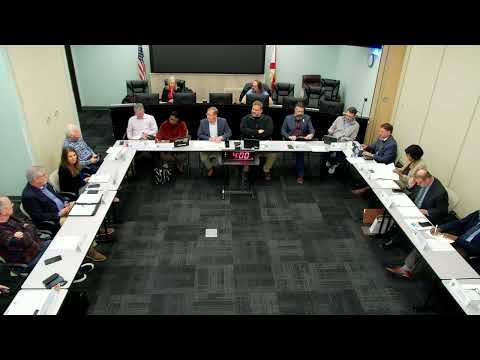
Panama City — City Manager Jonathan Hayes convened a roundtable of local housing providers, nonprofits and state housing officials to identify immediate gaps and coordinate resources to expand affordable housing in the city.
Speakers including Brooke Bullard of Anchorage Children’s Home, Brian Taylor of Doorways of Northwest Florida, Angela Clough of Habitat for Humanity and Sean Nesbitt of the Florida Housing Coalition outlined program capacities, funding sources and systemic barriers. ‘‘We’re not going to evict kids from this program,’’ said Brooke Bullard, describing the Bridge transitional living program for young people after the loss of a nationally competitive federal grant that created a roughly $250,000 annual shortfall for operations.
The meeting served as a stock‑taking session of local capacity and constraints. Brian Taylor, Doorways’ executive director, described the agency’s role as the Continuum of Care collaborative applicant and HMIS lead for a six‑county region and listed three primary challenges: housing availability, housing affordability and the absence of an emergency shelter in the immediate area.
Agencies described differing funding mixes. Catholic Charities, the Saint Bernard Project and Habitat for Humanity rely heavily on philanthropic and corporate donations to lower per‑unit costs; Habitat’s CEO Angela Clough said the organization has built about 116 homes locally and counted 812 volunteer contributors last year. Doorways and other service providers said HUD and state funds remain central but are insufficient and sometimes hard to access because local fair‑market rent figures can disqualify smaller markets for certain grant programs.
The Panama City Rescue Mission told commissioners it has requested a state appropriation of $6,000,000, with an expected split of about $4.5 million state and $1.5 million local match, to build two emergency shelters — a 47‑bed men’s facility and a 31‑bed women’s/family facility. The mission said the proposed shelters would operate with much lower screening barriers than its current program if the funding materializes.
City staff described existing programs: the housing office provides purchase assistance, rental assistance, owner‑occupied rehab, new infill construction and housing counseling, and reported counseling roughly 205 clients through purchase assistance programs last year. The Panama City Housing Authority said it serves more than 1,300 households through public housing and voucher programs, and that the voucher program includes roughly 642 families.
Panelists and commissioners focused repeatedly on three policy levers: 1) using public land or lowering land cost for projects, 2) expanding public‑private partnerships and project‑based vouchers to make tax‑credit or mixed‑income developments feasible, and 3) pursuing alternative delivery methods to lower construction costs. A guest with long housing authority experience recommended volumetric modular construction as one way to reduce labor inputs and accelerate delivery.
Florida Housing Coalition representatives closed the session by offering technical assistance and presenting a rough estimate that Panama City has a shortage of about 3,300 affordable units, with approximately 2,200 of those needed at 50% of area median income or below. They urged the city and partners to ‘‘use every available dollar,’’ modernize zoning to expand opportunities (including accessory dwelling units), and put local land to work for affordable housing.
The city asked the organizations to provide written lists of feasible partnership actions — funding, donated or discounted land, zoning/code changes and program ideas — and scheduled a follow‑up workshop within 30–45 days to move toward an action plan.
No formal votes or ordinance actions were taken at the roundtable; the outcome was an agreed set of follow‑up items and a commitment to continue coordination.
Ending — The roundtable closed after commissioners requested short recaps from each organization; city staff will consolidate responses and host a follow‑up workshop to convert ideas into an action plan.