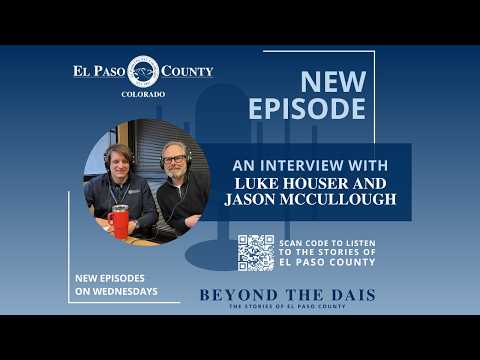
El Paso County explains how CDBG funds reach residents; Brothers Redevelopment outlines home-repair services
Loading...
Summary
El Paso County staff described how the county's Community Development Block Grant (CDBG) program distributes HUD entitlement funds to subrecipients serving low- and moderate-income residents outside Colorado Springs, detailed application timing and one-on-one intake for first-time applicants, and highlighted a long-term partnership with Brothers Redevelopment that provides subsidized home repairs and accessibility work.
Luke Hauser, a community development analyst in El Paso County's economic development department, and Jason McCullough of Brothers Redevelopment discussed how the county's Community Development Block Grant (CDBG) supports housing, public services and infrastructure for low- and moderate-income residents outside Colorado Springs.
Hauser said El Paso County earned entitlement status for CDBG from the U.S. Department of Housing and Urban Development in 2009, which allows the county to receive and allocate HUD entitlement funds for residents who live outside the Colorado Springs city limits. "Because Colorado Springs has its own entitlement of CDBG, we cannot mix the two funds for the clientele we serve," Hauser said, explaining that the county's awardable funds are limited to eligible residents outside the city.
The county accepts applications during a short annual window. Hauser said the current application cycle began Jan. 2 and runs through the first week of February (this year the deadline was Feb. 2). Applications undergo county review and are presented to the Board of County Commissioners for approval before the county seeks HUD authorization. Hauser described a roughly nine-month turnaround from application to receiving funds in many cases and noted the program operates on a 12-month grant cycle: county review through May'June, issuance of a notice-to-proceed typically in October, and then a 12-month performance period for subrecipients.
The county awards CDBG money to nonprofit organizations, municipalities, community-based development organizations, faith-based groups and institutions of higher education under five main categories: public services (the most competitive, often classroom-based services), public facilities and infrastructure (construction projects), economic development activities, and housing projects such as home repairs and accessibility upgrades.
Hauser said certain eligibility limits apply. "We can't pay for a vehicle, but we can pay for the gas that goes into the vehicle," he said as an example of allowable vs. disallowed costs; he also cautioned that construction materials should not "outlive the life of the grant." He recommended that prospective applicants contact county staff for specific allowable-expense guidance.
First-time applicants must complete a mandatory one-on-one intake meeting with county staff to assess project viability and funding fit. Hauser said these sessions generally last 30 to 60 minutes and are intended to ensure applicants are viable and aligned with both HUD matrix codes and one of the county's Consolidated Plan goals. The county's current Consolidated Plan (ConPlan) was set in 2022 and identifies the local priorities applicants should align with; Hauser noted the ConPlan period is ending in the coming year and that the county will reopen the grant cycle in the first week of January 2027 for future applicants.
Jason McCullough, who described Brothers Redevelopment as a nonprofit founded in 1971, said his organization has partnered with El Paso County as a subrecipient for many years and runs a home modification and repair program funded in part through local and grant sources. "We do home safety, accessibility, system repair, like deferred maintenance on major systems, and then aging home rehab," McCullough said. He emphasized that services are subsidized and recipients do not receive a bill; applicants must complete the organization's intake and reporting to document need and outcomes.
McCullough also advised prospective subrecipients to understand federal rules and maintain administrative capacity. "Read the CFR," he said, advising applicants to learn baseline federal requirements and to have the staff and reporting systems to comply with HUD rules. "If you don't report, it didn't happen," he added, underscoring that documentation and timely reporting are required for reimbursement.
Both speakers encouraged local organizations and residents to use county intake as the entry point. Hauser asked interested applicants to contact the county CDBG team at CDBG@elpasoco.com for a one-on-one assessment. McCullough pointed to Brothers Redevelopment's website (brothersredevelopment.org) for program details and to the statewide housing navigation resource coloradohousingconnects.org for broader housing assistance.
The county presentation listed practical cautions: CDBG is a useful recurring funding tool but not a guaranteed sole source of long-term funding; applicants should expect competition for grants, ensure their project is "shovel ready," and maintain the administrative systems necessary to track outcomes and bill only for completed work. The episode closed with host Scott Anderson thanking the guests and directing listeners to the podcast feed for more episodes.