Get email alerts on the Library Levy topic
No spam. Unsubscribe anytime.
Eugene council backs mid-cost library levy package, asks staff to explore kiosk pilot
Summary
After DHM Research polling showed the strongest, broad support for a mid-cost option emphasizing early childhood literacy, the Eugene City Council voted 8-0 to express support for Option 2 and requested staff return with kiosk-cost and scaling options before finalizing a ballot resolution.
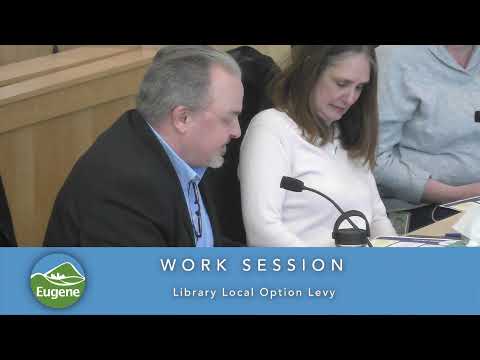
Councilors on Jan. 14 signaled unified support for a mid-level library levy that would preserve services and add early childhood literacy programs, voting 8-0 to express the council’s will to proceed with Option 2 while asking staff to return with cost details on vending-style kiosks and refined resolution language ahead of statutory ballot deadlines.
Joshua Bates, executive director of Library Recreation and Cultural Services, and Angela Ocana, the city’s library director, presented three levy packages that city staff and polling firm DHM Research tested. Ocana described Option 2 as building on maintenance of current services and adding an early literacy librarian, expanded story-time outreach and stronger youth collections; she summarized the packages’ approximate tax impacts as 15¢, 17¢ and 19¢ per $1,000 of assessed value (about $43, $49 and $56 per household per year, respectively).
Tony of DHM Research said the firm surveyed 400 likely May-2026 Eugene voters and found Options 1 and 2 outperform Option 3 in informed support testing. “If the proposed levy has a minimum of 60% informed support … in the absence of an organized opposition campaign … such measures have tended to pass,” he told council, explaining DHM’s rule-of-thumb for ballot viability.
DHM’s topline results, presented to the council, showed Option 1 at roughly 63% support on a bare ballot title (rising to about 69% after providing more detail), Option 2 at about 55% (rising to 62% with details) and Option 3 at about 47% (rising to 51%). In a head-to-head preference exercise, 29% of respondents said they favored Option 3, which DHM interpreted as a committed subgroup of voters rather than broad citywide viability for the most expensive package.
Several councilors praised the kiosk idea in Option 3—vending-style units that let residents pick up and return materials in neighborhoods like West Eugene or River Road—but DHM said the survey language tested only “expanded pickup and dropoff locations,” not vending kiosks explicitly. Library staff cautioned that kiosks entail hardware and ongoing staffing and delivery costs beyond the unit price, and that a smaller, pilot approach (one kiosk in an underserved neighborhood) could reduce fiscal impact.
Councilor Clark moved to express the council’s intent to proceed with Option 2 and to continue discussions after staff returns with additional details; the motion was seconded and passed by an 8-0 vote. Council instructed staff to bring back kiosk-cost and scaling options (including a possible Churchill/West Eugene pilot) and to return with materials for a resolution discussion on Jan. 28, noting Feb. 18 is the last day to act to place a measure on the May 19, 2026 ballot.
Councilors cited a mix of considerations: several said they prefer Option 2 because it is materially winnable across wards and prioritizes early literacy, while others urged staff to explore whether a limited kiosk pilot can be added without pushing the per-household cost above voters’ comfort. Staff confirmed Option 2 adds one full-time early literacy librarian plus temporary staff support and that levy-funded services would be prioritized if the city later faces general-fund reductions.
The council’s next steps are for staff to return with refined cost options and draft resolution language for further direction; no final ballot language was adopted at the Jan. 14 work session.
AI generated
The text on this page is AI generated. Summaries, highlights, analysis, and video transcripts are all produced from the original source material.
AI can make mistakes, so if you spot one, and we will fix it for everyone.
Note: the source content is unaltered by us. Any content source we link to, be it a video, an audio recording, or a document, is presented exactly as its publisher released it. That publisher is usually a government body, sometimes an individual official or another organisation.