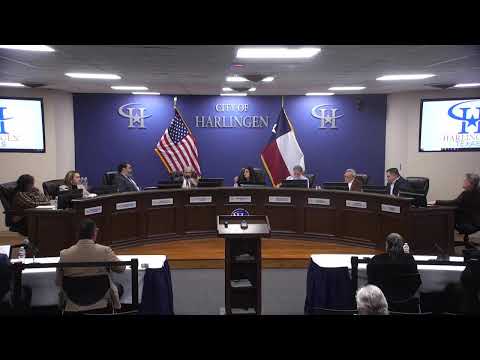
Harlingen commissioners debate advisory committee to move comprehensive, parks and downtown plans from paper to projects
Loading...
Summary
City commissioners discussed creating an IPOG planning advisory committee to prioritize projects from adopted plans and advise spending and grant strategy; commissioners split over committee composition, public input and funding limits, and one commissioner alleged previous votes could lead to eminent-domain actions — a claim the presiding official said was limited to a feasibility study.
Harlingen’s City Commission spent its workshop debating a proposal to create an IPOG planning advisory committee intended to shepherd the city’s comprehensive, parks and downtown plans from planning into execution.
The proposal, presented as Item 4, would form a committee to review adopted plans, compile prioritized projects and report recommendations to the commission. A commissioner who outlined the priorities asked the commission to focus first on projects already under construction — including Dixieland Park, City Lake, Lozano Plaza, Bowie Park, the soccer complex, Tom Wilson Sports Complex and the Bridal Colorado Hike and Bike Trail — then pursue smaller, less expensive parks in a second phase. That speaker also told the commission the parks department’s staffing had fallen from 45 employees to 32, and said the committee should help position projects for state and federal grant funding.
Supporters said the committee could provide a structure to ensure plans are not shelved and to generate public buy-in. “We need to plan it and get that little roadmap so staff and the community can hold benchmarks and know what we’re following,” said Speaker 1, the presiding official. Another commissioner urged including community members on committees so residents have ownership and to avoid purely top-down decision making.
Opponents warned the committee could create additional bureaucracy and emphasized limited city resources. “I’m against all of this,” said Speaker 5, who argued the city already has a city manager and assistant managers and that implementing the comprehensive plan would require far more funding than the city currently has. That speaker urged staff-led grant work and questioned creating a separate advisory body if it would simply add expense.
The commission discussed ways to balance those concerns. Staff and several commissioners described public-engagement measures, including workshops and QR-code outreach at project sites, to collect neighborhood-level input and to support successful grant applications. Staff also recommended that commissioners submit their priority lists so staff could compile a comprehensive list; the resolution presented to the commission would exclude streets and drainage projects from the committee’s scope.
A notable exchange grew heated when Speaker 5 said earlier votes had led to state-funded study activity that, in his view, opened the door to eminent-domain action to extend a trail through private backyards. The presiding official replied that the commission had only approved feasibility work and had not voted to seize property. “We did not vote to seize land or anything like that,” Speaker 1 said, describing the earlier action as due diligence to clarify jurisdiction and feasibility before any further steps.
Staff also said the city secured TxDOT funding for a study to extend a trail in District 5 and is working with the county to explore converting abandoned rail property to trail use. No formal motion or vote was taken at the workshop; staff and a number of commissioners said the item will return as an action item at a future meeting where the precise committee composition and guardrails can be decided.
The commission concluded the discussion without adopting the committee tonight and appointed follow-up work: commissioners will submit project lists and staff will prepare a refined resolution and additional information for the next meeting.