Ellington School District presents $1.4 million proposed budget increase; board to review detailed books
Loading...
Summary
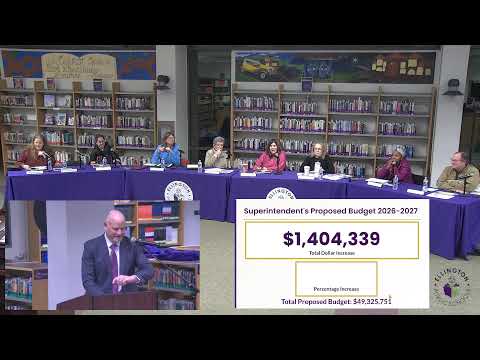
District staff presented a high-level budget review proposing a $1.4 million increase with a cited total of about $49 million, reviewed revenue sources (state education cost share, open-choice incentives, Medicaid reimbursements), staffing pressures and special-ed outplacement savings; board members will receive budget books and meet again for detailed review.
Oliver Barton led the Ellington School District’s special budget workshop, presenting a high-level review of spending, revenue streams and a proposed $1,400,000 increase for the coming fiscal year. Barton said the slides showed a total budget figure of $49,000,003.25, noted a modest year-to-year percent increase (roughly 2.9% as calculated in the workshop), and distributed budget books to board members for follow-up discussion.
Barton framed the budget amid rising costs and a goal to spend dollars efficiently. He showed comparisons with peer districts, saying Ellington is among the lower per-pupil spenders in a nine-district sample and called out that “we are $10,000,000 below the average spending in the district,” a characterization he used to explain the district’s relative position on a cost-versus-performance scatter plot. Barton identified EdSight Public as the source for the state accountability index used in the comparisons.
On revenues, Barton listed the primary streams: the state education cost share (which he said is flat for next year), adult-education reimbursements, open-choice enrollment funding, tuition from students who attend the district’s BASIS programs, Medicaid reimbursements tied to occupational and therapeutic services, and private or restricted donations. He emphasized that some Medicaid reimbursements are pass-throughs that cover the cost of services and are not discretionary funds the district can bank.
Staff described a recent open-choice enrollment tactic that pushed the district above a 4% threshold, triggering a state incentive of $2,000 per choice student; Barton said the change yielded roughly $200,000 in additional funding. Preschool (pre-K) enrollment is also growing, and staff said tuition will rise from $8,500 to $9,000 per full-day slot; tuition covers part but not all program costs and is supplemented by grant dollars.
Barton outlined labor costs as the dominant spending category: salaries represent about 64% of the budget and, including medical, dental and other employee costs, roughly 83% of total spending. He said teacher contracts contain a typical 2.9% cost-of-living adjustment and described a teacher-cost increase of about 5% between years driven by steps and contract terms. To manage pressures, staff said they have pursued multi-year account “right-sizing” to align funding to priority needs and improve predictability.
On special education, Barton said average IEP costs have fallen due to fewer out-of-district placements and the district’s BASIS programming, noting the district currently has about five students placed out of district versus higher historical counts. He cited outplacement examples exceeding $250,000 per child plus transportation as a driver of savings from serving students in-district.
Barton also presented a 12-position needs list from building principals; four positions were shown with no costs and eight were not funded in the current proposal. He said two lower-cost roles (one full-time and one 0.4 FTE) could be funded with a seed grant, and some roles might be supported by special revenue tied to BASIS programming.
Board members asked for clarifications about which students are included in per-pupil calculations, the breakdown of pre-K tuition versus grant support, and the precise composition of revenues and reserves. Staff committed to providing detailed account-level numbers at the upcoming finance committee meeting and the additional Saturday session. Barton confirmed both follow-up meetings will be streamed and that budget books were being handed out after the workshop.
A procedural motion to adjourn was made and seconded; the chair called the question, members responded “Aye,” and the motion passed, ending the special meeting.