Get Full Government Meeting Transcripts, Videos, & Alerts Forever!
Get email alerts on the Child Welfare Reunification topic
No spam. Unsubscribe anytime.
Judge Keeps Reunification Goal for Father in Lenawee County Review; Orders Documentation, Drug‑testing Follow‑up
Summary
A judge in Lenawee County maintained reunification as the permanency goal for two children of Austin Dubey, ordered the caseworker to provide reasons for a relative placement denial and additional documentation, and set a March 24 review; the court highlighted incomplete drug screenings, a pending psychological evaluation and transportation barriers to testing.
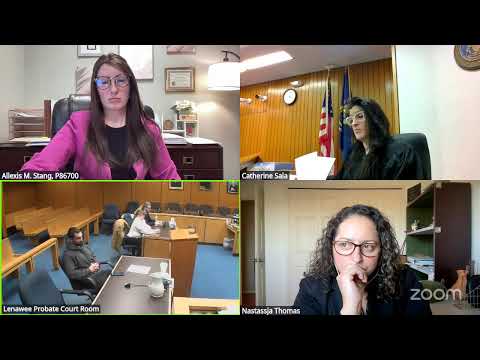
A Lenawee County Probate & Juvenile Court judge on Jan. 13 held that reunification remains the appropriate permanency goal for two young children removed from their father, Austin Dubey, and ordered caseworker follow‑up on drug testing, housing verification and family‑team supports.
The court accepted the court report and testimony describing that the children are doing well in their current kinship placement and are engaged with early‑intervention and community‑mental‑health (CMH) services. Mister Howell, the worker who reported on the children, said caregivers have provided stability and that the children ‘‘get along really well’’ in their current home. The record lists behavioral and developmental needs for the older child and an early‑intervention assessment for the younger child; a full review of that evaluation was scheduled for Jan. 21.
Caseworker Atlas told the court that Dubey completed a CMH intake and is expected to start substance‑use‑directed therapy in the coming weeks, but that several barriers to reunification remain: an incomplete psychological evaluation (placed on the calendar for the immediate reporting period), only partial completion of required services, and a drug‑testing plan that has not yet produced consistent, verifiable screens. Atlas described an attempted home drug screen (about 12:30 p.m.) where no one answered the door, two other agency testing attempts and transportation obstacles for a Jackson testing site that is the current referral location.
At the hearing, Alexis Steng, who identified herself as counsel for Dubey, questioned Atlas about dates and documentation. Steng requested proof that Dubey resides at his parents’ house (a lease or, if the parents own the home, a letter confirming residence) and confirmation of employment; Atlas said pay stubs or similar verification would satisfy the employment requirement. The court directed Atlas to include copies of referral emails and contact records in future reports and to provide a written explanation for why the paternal grandparents were denied for placement after a screened denial on Dec. 9, 2025.
Dubey testified that he works as a delivery driver for Domino’s and said he attended a CMH appointment; he told the court he expects therapy to begin Monday, Jan. 26 at 1 p.m. He disputed an allegation in a December visit report that he used an obscenity toward the children, saying he instead told his son ‘‘you’re not gonna freaking act like that’’ and denied using a stronger curse. He also said he would begin producing drug‑test results and pursue transportation options to comply with testing requirements.
The judge found the reunification goal appropriate, concluded that reasonable efforts toward reunification have been made and gave several directions: Atlas must provide the placement‑denial rationale and consider whether the grandparents’ status could be remedied to permit greater relative involvement; include counsel on emailed referrals going forward; and continue to prioritize verifiable drug testing and completion of parenting and other required services. The court set a review and permanency‑planning hearing for March 24 at 9 a.m.
The judge admonished Dubey that repeated claims of miscommunication risk undermining his credibility, urged him to complete drug testing and parenting time requirements and encouraged the parties to continue collaborative family‑team meetings. The court did not enter any change to custody at the hearing; reunification remained the court’s stated goal pending progress on the outstanding requirements.