Get Full Government Meeting Transcripts, Videos, & Alerts Forever!
Get email alerts on the 1pct Sales Tax topic
No spam. Unsubscribe anytime.
Punta Gorda officials debate including major utility projects in 1% sales tax slate
Summary
City leaders reviewed a utilities project list for the 1% sales tax program, identifying missing cost estimates, a $56 million water-treatment expansion with partial grant support, state limits on Shell Creek withdrawals, and disagreement over whether routine utility work belongs in the 1% funding package.
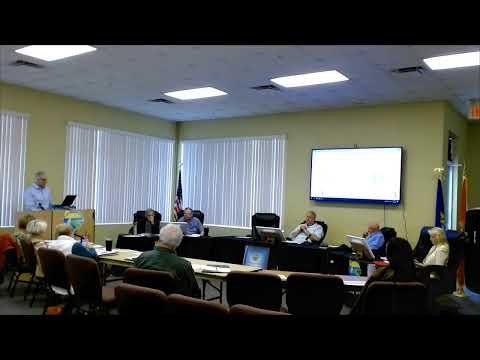
PUNTA GORDA, Fla. — Punta Gorda officials spent a workshop session reviewing a package of utilities projects being considered for the city's 1% sales tax program, flagging several large items without cost estimates and debating whether such work fits the tax program's intended purpose.
The most immediate technical constraint raised was explained by Rick Lemkoole, the city's grants coordinator. "We are able to make 14,000,000 approximately a day, but we are limited to about 8,000,000 gallons that we can actually make because of the restrictions that we can take from Shell Creek," he said, citing a state restriction from the Florida Department of Environmental Protection (FDEP) that has increased pressure for a planned expansion. Lemkoole told council members he has worked with staff on an SRF grant and other funding opportunities to address the capacity limit.
Why it matters: The restrictions on surface-water withdrawals mean the city may need a costly expansion of water-treatment capacity sooner than projected, pushing a $56 million project onto the near-term list even though the city already has "preliminary" grant support in the "15 and change or 17 and change" million-dollar range, according to staff discussion.
Council members and workshop participants raised three practical concerns: several packet items lack cost estimates, some project titles and line items appear misnumbered (staff identified a lift-station entry listed as "Lift Station 30 Rehab" while the narrative referenced "Lift Station 56" and staff said it will be corrected), and the scope of projects proposed for 1% funding may exceed what voters expect the tax to cover.
"There's one project here that's $50,000,000," one participant said, and staff confirmed there is at least one $56,000,000 item on the list that already has partial grant funding. Another attendee suggested outsourcing program management to accelerate completion of approved projects, while others cautioned that outsourcing has in the past produced construction bids over budget and scope changes.
A substantive policy dispute centered on whether the 1% sales tax should fund utility infrastructure. Ken Krause argued the tax should target projects that are not part of normal capital budgets, while others said utilities are generally expected to be self-supporting and that including many utility items risks voter rejection of the tax. One participant warned that rate increases already underway (one speaker referenced a 12% increase) increase the political sensitivity of asking voters to approve additional sales-tax spending on utility work.
Staff noted precedents where county allocations included utility projects and suggested a mixed approach might be possible. The workshop also surfaced a new $800,000-line item for marina improvements with limited detail; staff said repair work is underway and that a more defined project scope may be developed for future funding.
The group agreed to return the list next month with more detail and a proposed ranking. "We will bring these back next month for the final ranking," the chair said. A motion to adjourn followed; no vote was recorded on the motion in the provided transcript.
Ending: City staff will prepare clarified project sheets, correct numbering errors, and provide technical detail (with Director Tom Spencer or Steve expected to answer technical questions at a future meeting) before the council ranks projects at a subsequent meeting.