Get Full Government Meeting Transcripts, Videos, & Alerts Forever!
Get email alerts on the Baby Alexia Aot Reform topic
No spam. Unsubscribe anytime.
Guam bill to expand petitioning for assisted outpatient treatment advances with judiciary and behavioral-health safeguards urged
Summary
Senator Shelley Calvo's Bill 219-38 COR would expand who may petition for assisted outpatient treatment under the Baby Alexia Law; the judiciary and Guam Behavioral Health and Wellness Center urged training, strict clinical safeguards, clear notice and counsel rules, and capacity limits tied to a SAMHSA pilot grant.
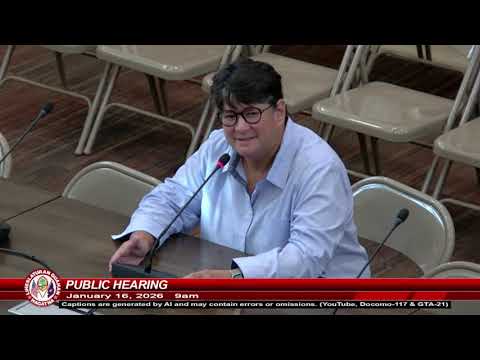
Senator Shelley Calvo opened a public hearing Jan. 16 on Bill 219-38 COR, the Baby Alexia Law Reform Act of 2025, which would expand who may file petitions to initiate court-supervised assisted outpatient treatment (AOT) under chapter 82a of the Guam Code.
Calvo said the measure seeks earlier intervention for people with serious mental illness, not broader criteria for involuntary treatment, and that it preserves medical involvement and judicial oversight. "It is about shifting from a reactive posture to a proactive one while remaining anchored in compassion, medical expertise, and respect for individual rights," she said.
Associate Justice Catherine Merriman and court administrator Danielle Rossetti testified for the judiciary, stressing the bill's importance but urging technical changes. The judiciary recommended standardized training for nonclinical petitioners, clearer definitions of terms such as "resident," limits on peace officers' authority to petition, removal or restriction of judges and attorneys as petitioners where conflicts might arise, appointment of counsel for indigent respondents, defined notice timelines (proposed 72 hours by certified mail or personal delivery), a hearing schedule (proposed no later than seven days after petition receipt), periodic review of orders, and specification of the applicable standard of proof (citing Addington v. Texas).
Rossetti read detailed, section-by-section proposed amendments into the record, and the judiciary offered to assist in drafting. Justice Merriman said expanding petitioner categories would let families and community providers seek civil AOT for people who otherwise end up in the criminal justice system.
Guam Behavioral Health and Wellness Center (GBWIC) submitted written testimony read into the record. GBWIC noted that SAMHSA awarded a four-year AOT grant described in testimony as roughly $500,000 (FY2026) to pilot a small caseload (about 20 clients per year) and cautioned that broad expansion of petitioning authority could create more petitions than the pilot team can manage. GBWIC recommended any expansion be scaled to actual staff and funding capacity and remain dependent on recommendations from qualified mental health professionals.
Committee members asked about available outcome data from the SAMHSA grant and about the mobile crisis response team and Crisis Intervention Training (CIT). Judiciary representatives said training and technical assistance are planned (including late-February AOT technical assistance and ongoing SIM mapping/CIT training) and described instances where mobile crisis teams helped divert people away from arrest and into care.
No committee vote on the bill occurred Jan. 16. Senators said they would accept the judiciary's technical recommendations and GBWIC's capacity cautions and that they will work on amendments and further coordination with technical assistance visitors expected in late February, with the aim of taking the refined bill to markup and potentially to the March session agenda.