Department of Public Health: quarterly nursing home report shows 89.2% average occupancy and 2,323 open beds
Loading...
Summary
The Department of Public Health reported an average nursing-home occupancy rate of 89.2% for the quarter ended 12/31/25, approximately 2,323 open beds statewide, 191 nursing homes total, and five immediate jeopardy incidents across four facilities; committee approved the prior minutes and adjourned after a short Q&A.
The Department of Public Health presented quarterly nursing home oversight data, reporting an average occupancy of 89.2% for the quarter ended Dec. 31, 2025, and approximately 2,323 open beds statewide.
"For the quarter ended 12/31/25, the average occupancy was 89.2%," said Nick Mazzato, the meeting presenter. He told the committee monthly occupancy was 88.9% in October, 89.6% in November and 89.2% in December.
The presentation, given jointly by Department of Public Health staff and attendees from the Department of Social Services, noted Connecticut had 191 nursing homes as of the end of the quarter. The report included a map and bed-count breakdown showing facility sizes from small to 200-plus-bed operations.
Officials said there were no receiverships, bankruptcies or temporary managers reported for the quarter. The presenter noted one closure during state fiscal year 2026—Saint Joseph Center—but said that closure had occurred previously and was recorded in the quarter’s activity. The Department of Social Services reported there were no hardship interim-rate requests submitted for the quarter.
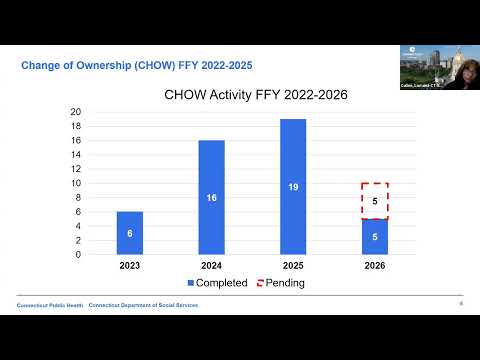
Lorraine Cullen, branch chief of health care quality and safety at the Department of Public Health, summarized change-of-ownership activity: the report was rebased to federal fiscal year, with 19 ownership changes in federal fiscal year 2025 and five completed plus five pending in the first quarter of federal fiscal year 2026. Cullen cited multiple ownership changes at Athena Homes and said one not-for-profit facility sold to a for-profit.
Cullen listed the quarter’s top five frequently cited federal deficiencies and gave examples: failures of staff supervision that led to delayed identification of a missing resident, quality-of-care shortfalls where assessed needs were not met, failures to secure medication carts, lapses in infection-control practice such as not changing oxygen tubing per facility policy, and failures to develop or implement comprehensive care plans related to fall prevention.
"We had five immediate jeopardies across four facilities," Cullen said, identifying those IJs as related to free-of-accident/hazard/supervision issues, respiratory/tracheostomy care and suctioning, care-plan implementation, and quality-of-care concerns. She also showed a historical trend line of immediate jeopardies across federal fiscal years, with five IJs highlighted for fiscal '26.
During discussion, committee member Mag Morelli asked whether the department tracks the source of deficiencies—annual survey, complaint survey or self-reported incident. Cullen replied the department does track that information and offered to provide it to interested members, noting it is not routinely shared with the entire committee.
Procedural items: the committee moved and approved the Oct. 8 meeting minutes (motion moved by Matt Barrett and seconded by Lorraine Cullen). Later, Barbara Katz moved to adjourn; the motion was seconded by an unnamed participant and the meeting concluded.
The department said it will share additional data on deficiency origins on request; no formal votes on policy or funding were taken during this session.