Get Full Government Meeting Transcripts, Videos, & Alerts Forever!
Get email alerts on the Human Services Grant topic
No spam. Unsubscribe anytime.
San Luis Obispo opens 2026–27 human services grant round with homelessness as top priority
Summary
City of San Luis Obispo Office of DEI held an information session outlining the Human Services Grant for July 1, 2026–June 30, 2027: applications open Jan. 20, due Feb. 24 by 5 p.m. PST; awards range $5,000–$20,000 (up to $40,000 for partnerships); priority will be projects that prevent or address homelessness.
The City of San Luis Obispo’s Office of Diversity, Equity, and Inclusion held an online information session to explain eligibility, application requirements and deadlines for the Human Services Grant for the 2026–27 funding year.
“We are wanting to make it as easy and accessible as possible,” said Samantha Dave Bonham, diversity, equity, inclusion administrative specialist for the City of San Luis Obispo, introducing the session. Matt Pennan, manager of the office, outlined review and contracting steps the city will use to shepherd applications through the Human Relations Commission and city council.
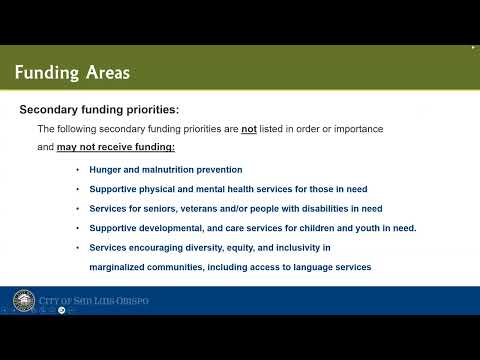
Why it matters: The city’s general fund supports the Human Services Grant, and officials said the priority for this cycle is preventing and addressing homelessness. The Human Relations Commission (HRC) is to fund all qualified applicants meeting that main priority before considering secondary categories such as hunger prevention, supportive physical and mental health services, services for seniors, veterans and people with disabilities, youth services, and programs advancing access and belonging.
Who can apply and typical awards: Application request minimums and maximums were stated at $5,000 minimum; up to $20,000 for a single organization and up to $40,000 for partnerships. Only one award is allowed per organization unless the proposal is a collaborative project; a lead applicant with 501(c)(3) fiscal‑agent status is required for partnerships.
What activities are eligible: City staff listed examples tied to the homelessness priority—rental subsidies or rapid rehousing and operating subsidies for permanent housing, homelessness prevention services (including rental assistance and problem‑solving), interim housing options such as motel vouchers or shelters, and nonhousing services such as street outreach, hygiene services or legal assistance. Staff said applicants should clearly show how city funds will impact San Luis Obispo residents and how proposed services will be delivered within city limits.
Application materials and review: Applicants must complete an online application (the system does not save drafts) and either attend an information session or attest to reviewing the recording. Required attachments include a one‑page program budget, a one‑page organizational chart, and proof of 501(c)(3) status (or a fiscal agent for partnerships). The city now requests an “access and belonging” statement describing how the proposal advances access and belonging for city residents, replacing the previous DEI statement.
Anti‑discrimination and compliance review: Matt Pennan emphasized that “grant funds from the City of San Luis Obispo must be available to all otherwise qualified individuals,” and that staff will screen applications against federal anti‑discrimination laws; applications that appear to violate those standards will be pulled before HRC review. If an applicant’s program has externally required eligibility criteria tied to other funding sources, staff said those limits should be documented in the application.
Contracting, reporting and recordkeeping: Awarded organizations must sign a contract with the City before receiving funds; if council approves HRC recommendations, funds will be released in a single lump sum. Grantees must submit two online reports per grant cycle (midyear and end of year) and retain financial and program records for five years; the city will allow 10 calendar days of leeway for report submission, but failure to file or communicate could render an organization ineligible for city grants for up to three years.
New requirements and restrictions: The city will require awarded organizations to post a prescribed statement—verbatim as provided by the City—on their homepage or an equivalently visible page within 10 calendar days of contract execution, signaling that City funds are open and accessible to all. The City also clarified prohibited uses: funds cannot be used for political campaigning or ballot measures, promotion of religion, payment of city fees/permits/fines, or personal expenses not tied to the approved project. The office said stipends or honoraria and similar direct payments to individuals will no longer be allowed as a use of grant funds, though salaries and project‑related personal expenses remain permitted; any exceptions must be written into the contract exhibit.
Timeline and next steps: The application opens Jan. 20; technical assistance hours are scheduled for Feb. 4 (1–4 p.m.); applications are due Feb. 24 by 5:00 p.m. PST (late submissions will not be accepted). The HRC subcommittee will review applications in March (those subcommittee meetings are not public); a public HRC meeting is scheduled for April 1 at 5:00 p.m. at City Hall, where applicants may speak for up to three minutes. HRC recommendations are expected to go to city council in May, contracts in June and funds disbursed by July. The grant period is slated to run from 07/01/2026 to 06/30/2027. Staff said the Office of DEI will post the session recording and slide deck online and will email registrants directly.
Questions and examples: Attendees asked for slides and clarification on pass‑through funding and eligibility for specific programs. A food‑bank representative asked whether no‑cook bags for people experiencing homelessness could qualify under supportive services; staff said yes if the application demonstrates direct service to people experiencing homelessness. Attendees raised technical questions about website language and whether partners or pass‑through recipients would also need to post the required statement; staff said they would consult the city attorney and follow up.
What’s next: Applicants should review posted materials, plan their one‑page budget and access/belonging statement, and use technical assistance hours or email staff with questions. The HRC public hearing and city council review offer opportunities for public comment and to review recommendations before final awards are executed.