Get Full Government Meeting Transcripts, Videos, & Alerts Forever!
Get email alerts on the Cascadia Resolution topic
No spam. Unsubscribe anytime.
Advocates press Portland committee to adopt Cascadia earthquake resolution; bureaus say more planning and resources needed
Summary
Community groups urged a resolution directing city bureaus to integrate Cascadia Subduction Zone risks into planning and the Comprehensive Plan; bureau staff acknowledged gaps in resources and coordination and the committee asked bureaus for feedback ahead of a revised resolution.
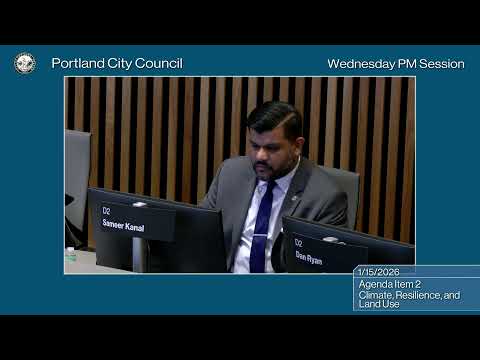
Community members and climate and safety organizations told the Climate Resilience and Land Use Committee on Jan. 15 that the city should adopt a resolution to make Cascadia Subduction Zone earthquake risk a foundational consideration across city planning, emergency preparedness and economic policy.
Presenters and their asks: Heather King (Lower Willamette Riverkeeper) and other presenters asked the committee to require city bureaus to assess how a predicted Cascadia earthquake would affect planning, services and infrastructure. Nancy Heizer (Tank the Tanks) raised detailed concerns about the CEI hub (industrial facilities): she asked whether the city has plans for bridge and communications failure, and warned that water shortages after an earthquake would render standard fire-suppression systems ineffective.
David Labbe cited a 2018 Oregon Department of Geology study that estimated extensive damage to industrial and commercial buildings in Multnomah County and argued the city’s Economic Opportunity Analysis had not accounted for those risks when identifying riverfront industrial land for future job growth. Nikki Mandel and others asked for three resolution directives: that bureaus explicitly incorporate Cascadia risk into planning and mitigation; that the city pursue multi-jurisdictional coordination; and that the Bureau of Planning and Sustainability review the Comprehensive Plan for Cascadia vulnerabilities across its guiding principles.
Agency responses and capacity: Eric Angstrom, Director of Planning and Sustainability, acknowledged geography and historical decisions constrain options and cited prior resilience-driven actions (for example, Burnside Bridge prioritization) while saying the topic is under‑resourced. Ratchet Norell, Chief Resilience Officer at PBEM, said some plans exist but are out of date and that PBEM is understaffed for the scale of work required; the bureau recently received budget resources and is hiring but is not yet where it needs to be.
Council reaction and next steps: Councilors expressed support for further work and pointed to specific priorities—evacuation routes in North Portland, industrial firefighting capacity, and water-supply solutions for post-quake firefighting. The committee asked bureaus to provide feedback and coordinate a revised resolution for future consideration; no ordinance or binding action was adopted on Jan. 15.
Closing: Presenters emphasized private-facility responsibility as part of any mitigation strategy and suggested convening facility operators to explore collective solutions (for example, shared water or mutual-aid arrangements). The committee committed to keeping Cascadia planning on its agenda and to returning with further bureau analysis and potential language revisions.