Get Full Government Meeting Transcripts, Videos, & Alerts Forever!
Get email alerts on the State Governance Initiatives topic
No spam. Unsubscribe anytime.
Senate President Stewart Adams warns against out-of-state initiative campaigns, urges Utah to boost energy, minerals and water resilience
Summary
Speaking at a Utah Eagle Forum event, Senate President Stewart Adams said a recent Utah Supreme Court ruling limits the legislature’s ability to change voter initiatives, warned that out-of-state initiative campaigns can "override our republic," and called for expanded energy production, domestic mineral processing and regional water solutions.
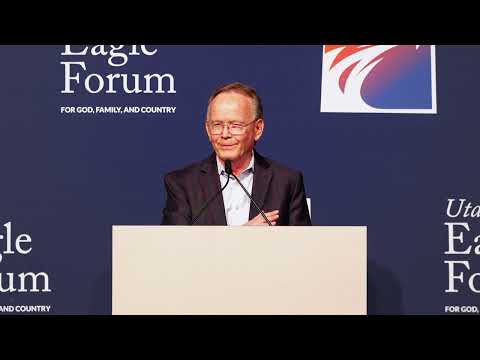
Senate President Stewart Adams told attendees the state must guard its representative institutions and invest in energy and resource security in remarks at a Utah Eagle Forum event.
Adams opened by praising Utah’s business rankings and civic life, saying, “I think Utah is the best state in the nation,” and citing national rankings that rate Utah highly for business and economic outlook.
He framed the day’s remarks around constitutional principles, directing attendees to a distributed booklet and asking them to read Article IV—"The United States shall guarantee to every state in this union a republican form of government." He pledged "to support, obey, and defend the constitution," speaking from a legislative leader’s perspective.
Adams criticized what he described as judicial overreach and a recent Utah Supreme Court ruling (not specified in the remarks) that, he said, constrains the legislature’s ability to amend or revise voter-approved initiatives. "If an initiative...alters government, we are under strict scrutiny," he said, adding that external groups from other states "should not run initiatives and override our republic." He cited Oregon’s Ballot Measure 110—which he described as reclassifying possession of several controlled substances as a class E civil violation punishable by a small fine—as an example of an initiative he said had harmed that state.
Turning to national competitiveness, Adams warned of an "arms race" over artificial intelligence and said that control of AI will confer strategic advantage. He recounted visiting Bucha, Ukraine, to underscore the human stakes of modern conflict and said AI-driven systems such as drones are reshaping how wars are fought.
Linking AI to infrastructure needs, Adams argued the technology requires large data centers and therefore reliable power. He said the United States risked falling behind because of constraints on domestic fossil-fuel production while other countries continue to build generation capacity. "We're going to push to make sure Utah is a center for energy production," Adams said, noting Utah’s relatively low electricity and gasoline prices.
Adams also raised supply-chain concerns, saying China controls large shares of critical-mineral supply chains—he stated about 60% of mining and about 90% of refining—and urged Utah to develop its own minerals: "In Utah, we have 40 of the 50 critical minerals," he said, adding the state should mine and process more domestically.
On water, Adams said the state has created a "water agent" who is coordinating with other states and learning from Israel’s desalination efforts. He proposed regional cooperation, saying Utah could help supply desalinated water to parts of California as part of a negotiated approach to Colorado River shortages.
Adams closed by reiterating support for limited government and free markets and saying lawmakers intend to pursue further income-tax reductions. He thanked attendees and praised Utah residents’ civic and charitable contributions.
The remarks included multiple policy proposals and assertions attributed to Adams; the Utah Supreme Court ruling he cited was not named in the speech, and several statistics were offered by Adams as part of his argument.