Get Full Government Meeting Transcripts, Videos, & Alerts Forever!
Get email alerts on the Racial Equity topic
No spam. Unsubscribe anytime.
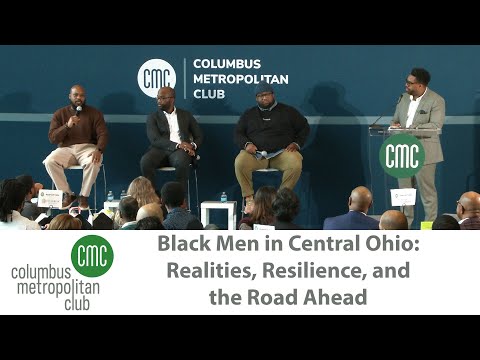
Panel at Columbus Metropolitan Club urges action on disparities, highlights 'rest' and scaled solutions for Black men
Summary
Speakers at a Columbus Metropolitan Club forum urged policymakers and institutions to pair community healing with scaled policy action to close racial gaps, warning tech-driven job shifts could worsen disparities and stressing therapy, mentorship and restorative community supports.
A panel at the Columbus Metropolitan Club on Jan. 15, 2026, framed the challenges facing Black men in Central Ohio as the product of long-standing systems, not individual failings, and called for scaled policy action and community-based healing.
Matt Barnes, the forum host, opened the program at the National Veterans Memorial and Museum by saying the discussion would examine disparities in health, education, income and incarceration and spotlight resilience and leadership in the Black community. Moderator Corey Faber asked panelists what being a Black man in Central Ohio looks like today.
Jason Jenkins, identified by the forum as chief diversity officer and executive director of the City of Columbus Office of Diversity and Inclusion, described the moment bluntly: being a Black man is "hard," he said, noting the pressure to "show up better" and the limited runway to recover from setbacks. Jenkins and other panelists emphasized the importance of intentional spaces where men can rest and process trauma.
Duann Pinder, a partner at McKinsey & Company who leads the Institute for Economic Mobility work referenced onstage, framed the problem with data. He told the audience that Black men in Franklin County "are doing about half as well as white men" across 25 metrics, and warned that automation and artificial intelligence threaten many of the occupations where Black men are overrepresented. "It would take 700 years to close the racial disparities" in the region under recent trends, Pinder said, a projection he offered to underline the need for bold, scaled action.
Marshall Shorts, founder of Artfluential and creative director at the Ohio Organizing Collaborative, urged that rest itself be treated as a form of resistance. "What does it look like to rest as a form of resistance?" he asked, and said creating spaces where men can be vulnerable and receive mutual support matters for long-term healing.
Panelists recommended practical supports alongside cultural change. Jenkins and others promoted therapy and peer mentoring; Jenkins repeated the endorsement, saying, "Therapy, therapy, therapy." The panel also named organizations and networks working locally, including Black Men Build and My Brother's Keeper, and urged support for groups that do gender-inclusive community work.
During a moderated audience Q&A, panelists answered questions about how Black men and women can support each other; the panel acknowledged that disparities for Black women are greater in some areas and highlighted early-childhood education and childcare as priorities that also support working parents. When asked about scalable examples, panelists cited Baltimore's mayoral efforts to fund community intervention workers as a model for combining prevention, employment and local leadership.
Panelists repeatedly said that the city and private-sector institutions must move beyond conversation to design and fund programs at scale. The forum closed with a call to continue the conversation across neighborhoods and institutions and noted recommended reading and local library resources for further study.
The Columbus Metropolitan Club said the conversation should lead to action, and the Columbus Metropolitan Library highlighted resources, including Courtney B. Vance's book referenced at the event. The forum organizers encouraged attendees to keep engaging locally and to return for future CMC programs.