Get Full Government Meeting Transcripts, Videos, & Alerts Forever!
Get email alerts on the Solid Waste topic
No spam. Unsubscribe anytime.
LPA pauses decision on Largo transfer station after split vote; applicant adds asbestos and dust controls to development agreement
Summary
After months of public complaints about dust and health risks, the Local Planning Agency split on the land‑use motion for a proposed transfer station in unincorporated Largo and ultimately agreed to continue FLU25‑06 / ZON25‑04 to Feb. 11 at the applicant's request. The development agreement now includes asbestos and particulate‑control language, paving of vehicle areas and on‑site truck queuing.
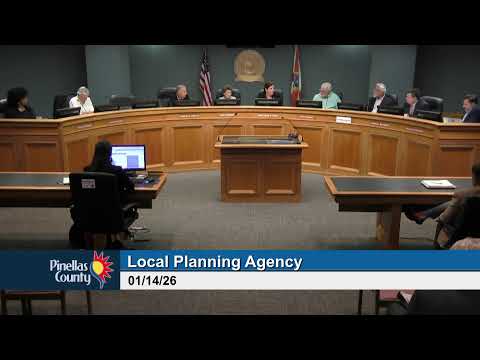
The Pinellas County Local Planning Agency on Jan. 17 considered companion land‑use and zoning applications (FLU25‑06 and ZON25‑04) for a roughly 1.87‑acre property in unincorporated Largo proposed for a solid‑waste transfer station with accessory outdoor sales and parking. After extended public testimony about airborne dust and a split board vote on an approval motion, the applicant asked for and received a continuance to the February meeting (the LPA recorded Feb. 11 as the return date).
Scott Swearingen, Pinellas County’s long‑range planning manager, told the board the package would change the northern 1.18 acres from commercial neighborhood to commercial general and the remaining 0.69 acres from employment to industrial general, increasing the range of industrial and commercial uses allowed by the land‑use and zoning categories. Swearingen emphasized, however, that the applicant had offered a development agreement limiting the property’s use to a narrow package — a transfer station, outdoor sales and parking — and that the development agreement included new commitments since the last LPA hearing.
"Staff recommends approval," Swearingen said, adding that staff found the changes consistent with the comprehensive plan and compatible with surrounding industrial and commercial uses.
The development agreement additions presented to the board included: a requirement that the transfer‑station operation include controls to prevent asbestos from entering the facility’s internal waste stream and compliance with state particulate‑matter controls (the applicant referenced rule 62‑701.315, FAC); a binding conceptual site plan; a requirement that truck queuing occur on‑site rather than on neighborhood streets; and a note that drive aisles and parking areas be paved in conformance with county code. The applicant indicated random samples had been sent to a lab and "came back clean," and the applicant also agreed to add the word "lead" into the asbestos/particulate section after a board request.
Residents and nearby property owners opposed the applications at the hearing. Steve Kawal, a nearby warehouse owner, said dust from on‑site activity has coated cars and affected air quality for years and that sprinklers used by the operator were insufficient. Darlene Shirley, a resident, cited flooding in adjacent ditches and health concerns for family members with respiratory illness.
John King, representing the operator Green Energy Transport, said the operator has implemented spray‑down systems and now runs sprinklers early in the morning; he said additional mitigation options such as misters or water cannons and supplemental water tanks had been discussed to increase dust control. Craig Juraski (applicant representative) told the board the site plan had been revised to call out paving of drive aisles and parking and that a spray‑down facility exists for incoming loads.
Board deliberations reflected competing priorities: some members worried the county was being asked to regulate operational matters better handled by permitting or enforcement agencies, while others said the redlined development agreement language and paving commitments addressed LPA concerns about dust and water quality. An initial motion to approve FLU25‑06 failed on a split vote. A subsequent motion to recommend denial was placed on the record and a roll call occurred; before the board finalized a recommendation, the applicant asked to continue the matter and the LPA voted to continue both the land‑use and zoning cases to the February meeting to allow full board participation and time to refine DA language.
What happens next: The LPA’s recommendation (or lack of a final recommendation) will be transmitted to the Board of County Commissioners; the applicant is expected back before the LPA in February. If the applicant proceeds, site‑plan review and permitting will evaluate paving, stormwater controls and any permit conditions the county or state may require to address dust, asbestos, lead or other contaminants.