Get Full Government Meeting Transcripts, Videos, & Alerts Forever!
Get email alerts on the Retirement Trust Governance topic
No spam. Unsubscribe anytime.
OLO recommends code changes, more expert trustees in review of county retirement trust governance
Summary
Montgomery County’s Office of Legislative Oversight presented research recommending clarifications to County Code on roles for the CAO, BIT and CRHBT, a shift of actuarial‑assumption authority to the Board of Investment Trustees, and consideration of smaller boards with more subject‑matter experts; the committee scheduled further review alongside Bill 20‑824.
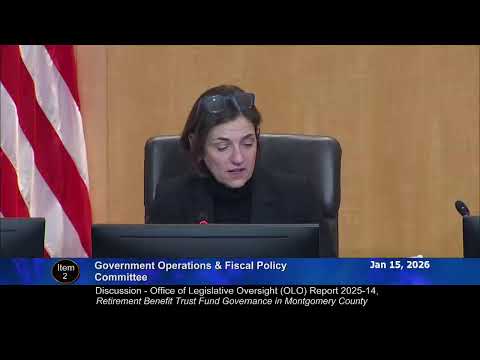
The Office of Legislative Oversight presented a detailed review of Montgomery County’s retirement and retiree health benefit trust governance and recommended that the County Council consider amending the County Code to clarify responsibilities and, where appropriate, shift responsibilities to the boards that manage investments.
OLO analyst Mr. Trumka told the Government Operations and Fiscal Policy Committee that national practice usually gives trust boards authority to select actuaries and set actuarial assumptions. He said the county is an outlier: County Code §33‑47 assigns broad administrative duties to the chief administrative officer (CAO), including selecting the actuary and determining actuarial assumptions, while the Board of Investment Trustees (BIT) has exclusive responsibility for investment of trust fund assets.
"The actuary serves the county's retirement system, the entirety of the retirement system," Trumka said in explaining OLO’s recommendation to retain CAO authority to select the retirement system actuary while shifting most actuarial‑assumption decisions (notably the assumed rate of return) to BIT. OLO also recommended code language to clarify CRHBT administration and to have BIT (and, to some extent, CRHBT) select the MCERP executive director after the CAO oversees recruitment and vetting.
Trumka summarized OLO’s literature review and expert interviews: boards in most jurisdictions select actuaries and determine actuarial assumptions; a NCPERS survey OLO commissioned found 87 percent of respondents reported the board hires the executive director. OLO also reported that, based on published actuarial performance reports, BIT’s long‑term performance is in the top quartile and CRHBT’s performance is in the top half, though more recent short‑term data were not available to the analyst.
Council members used the presentation to press for context. Councilmember Katz asked how Montgomery County’s investment performance compares to peers, and Trumka said the BIT ranks in the top 25 percent over the past decade. Council Member Evans asked about disadvantages of reducing board size; Trumka cited research and experts who said larger boards are not generally associated with better outcomes and can hinder functionality, but emphasized reconstituting current boards is a Council judgment.
Next steps: the chair noted a public hearing on Bill 20‑824 is scheduled for Jan. 26 and the committee will take up the bill on Feb. 5; OLO will accept trustee and CAO written comments appended to the report and the committee invited additional comments before the hearing.