Get Full Government Meeting Transcripts, Videos, & Alerts Forever!
Get email alerts on the Active Transportation Monitoring topic
No spam. Unsubscribe anytime.
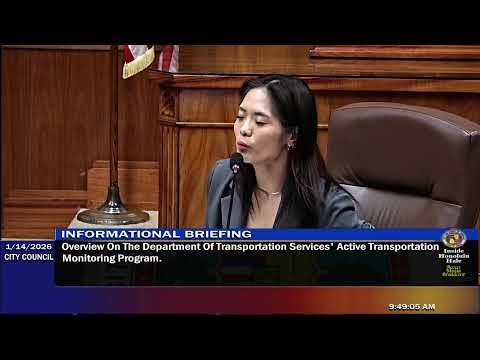
DTS outlines islandwide active-transportation monitoring program with public data portal
Summary
The Department of Transportation Services briefed the committee on an active-transportation monitoring program that now has 31 permanent counters, approximately 60 short-term sites on a three-year cycle, scooter detection capability, and publicly accessible daily-uploaded count data funded in part by Oahu MPO and FHWA grants.
The Department of Transportation Services told the committee Wednesday that its active-transportation monitoring program now includes 31 permanent pedestrian and bicycle counters across Oahu, a public data portal, and about 60 identified short-term sites to be counted on a roughly three-year rotation.
"We're really good at collecting vehicular data," Daniel Alexander, chief of the regional planning branch at DTS, said in the briefing. "We historically have not been great about collecting pedestrian and bicycle data ... so, with this program, we've set out to fill that gap." Alexander said the permanent network includes 12 joint pedestrian/bike counters, 17 bicycle-only counters and two pedestrian-only counters; the most recent five counters installed in 2025 also record scooters and other micro-mobility.
Alexander showed sample December counts for a site near a rail station that recorded close to 6,000 users in a month, with bicyclists making up over half of users and pedestrians about a third. He said the program received funding support from the Federal Highway Administration through the Oahu Metropolitan Planning Organization and that the permanent devices are intended to run for at least 10 years.
On maintenance and costs, Alexander said the counters are battery powered and require battery replacement about every two years; two devices required controller replacements (about $5,000 each when that work occurred), and the program pays a subscription fee for data transmission and hosting. He said the Oahu MPO funding supports ongoing maintenance and some staff time for field technicians.
On data privacy and format, Alexander clarified the devices do not record images: pedestrian counters detect body heat and sensors in the pavement detect magnetic signatures from bikes and scooters. "It's literally like a data point ... it just says scooters. It says bike. Just 1, and it'll have a time stamp on it," he said. The devices upload daily to a cloud-based system and DTS provides a public dashboard for analysis.
Committee members asked how counts would be used. Alexander said the data enable exposure-based crash analysis, project evaluation (he cited trip increases after protected-bike-lane extensions), and updates to the Oahu bike plan. DTS said it will provide the committee with the planned short-term site list for the next phases and continue seeking OWP funding to support the program.