Get Full Government Meeting Transcripts, Videos, & Alerts Forever!
Get email alerts on the School Funding Formula topic
No spam. Unsubscribe anytime.
Waynesboro bodies agree to keep talking after city proposes 3% cap on school funding increases
Summary
City staff proposed a revision to the long‑standing Waynesboro funding formula that would cap year‑over‑year municipal contributions to the schools at 3%. School leaders urged fuller data review and both bodies agreed to continue joint and 2‑on‑2 meetings with a target follow‑up in April rather than taking immediate action.
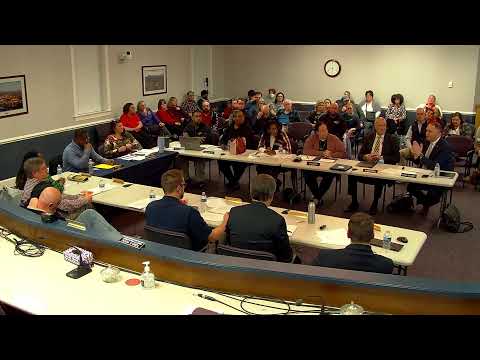
Waynesboro City Council members and the Waynesboro School Board met in a joint session on Jan. 13 to discuss a city proposal to limit year‑over‑year increases in the municipal portion of school funding to 3 percent.
A municipal presenter summarized the proposed amendment and the formula’s mechanics, saying, “The proposed amendment would establish a maximum increase of amount of 3% per annum per year.” City staff told the joint meeting that projections indicate the 3 percent maximum would not reduce school revenues for fiscal 2027 and described the change as a tool to preserve municipal capacity for capital and operational investments as the city plans a major high school project.
City staff noted the council anticipates issuing debt for a high school project they estimated at about $60,000,000 and said that historically a 3 percent cap would have affected the formula in several past years. Finance staff explained the existing formula pulls a list of discretionary revenues from audited financial statements, subtracts specified withholdings (examples cited in the presentation), then applies a 42.5 percent share to determine the municipal allocation to schools.
School division leaders pushed back on several points and urged more complete review of the underlying data. Dr. Castle (who presented the school material) said Department of Education enrollment and ADM figures do not capture all students the division serves and that specialized and federally required programs raise costs. “If you go to the Virginia Department of Education website and look at our enrollment, it says 3,013 students when you include all of our students,” Dr. Castle said, and added the division now serves about 80 students in intensive‑support programs and cited about 106 students identified as experiencing homelessness — both figures the school leaders said make budget pressures more acute.
School staff showed a simple per‑pupil calculation using the city contribution figure the presenters provided: city contribution divided by the stated student count produced roughly $6,685 per pupil for the year cited. They also said economic development incentives that were withheld from the formula in past years totaled roughly $9,000,000 and that, when those incentives return to the formula, the school share at 42.5 percent would be approximately $4,200,000.
Council members and school board members debated process. Some council members said elected officials should make the final call without hiring an outside consultant; others suggested a third‑party efficiency or finance study would be helpful. School board members asked for more time and for the two bodies to continue negotiations in public joint sessions and smaller 2‑on‑2 meetings so that both sides could examine the same data and prepare counterproposals. One school board member said, “I don’t want my tax rate to go up personally, but I feel like we all need to make sure we’re doing our due diligence,” urging care in any change that would limit school funding growth.
Rather than advancing a resolution, both bodies agreed to continue conversations and to aim for a follow‑up timeline in late April, with the school board preparing a counterproposal and both staffs exchanging the detailed data that underlies the formula calculations. No formal vote on the funding formula amendment was taken at the joint session. The meeting concluded with a motion to adjourn that carried by voice vote.
What happens next: Participants said they would schedule additional joint and 2‑on‑2 meetings, exchange detailed audited financial and enrollment reports, and aim to return with a shared timeline and, if appropriate, a formal proposal by late April for further public consideration.