
Lawton honors Martin Luther King Jr. with readings, spoken word, cultural dances and community awards
Get AI-powered insights, summaries, and transcripts
Subscribe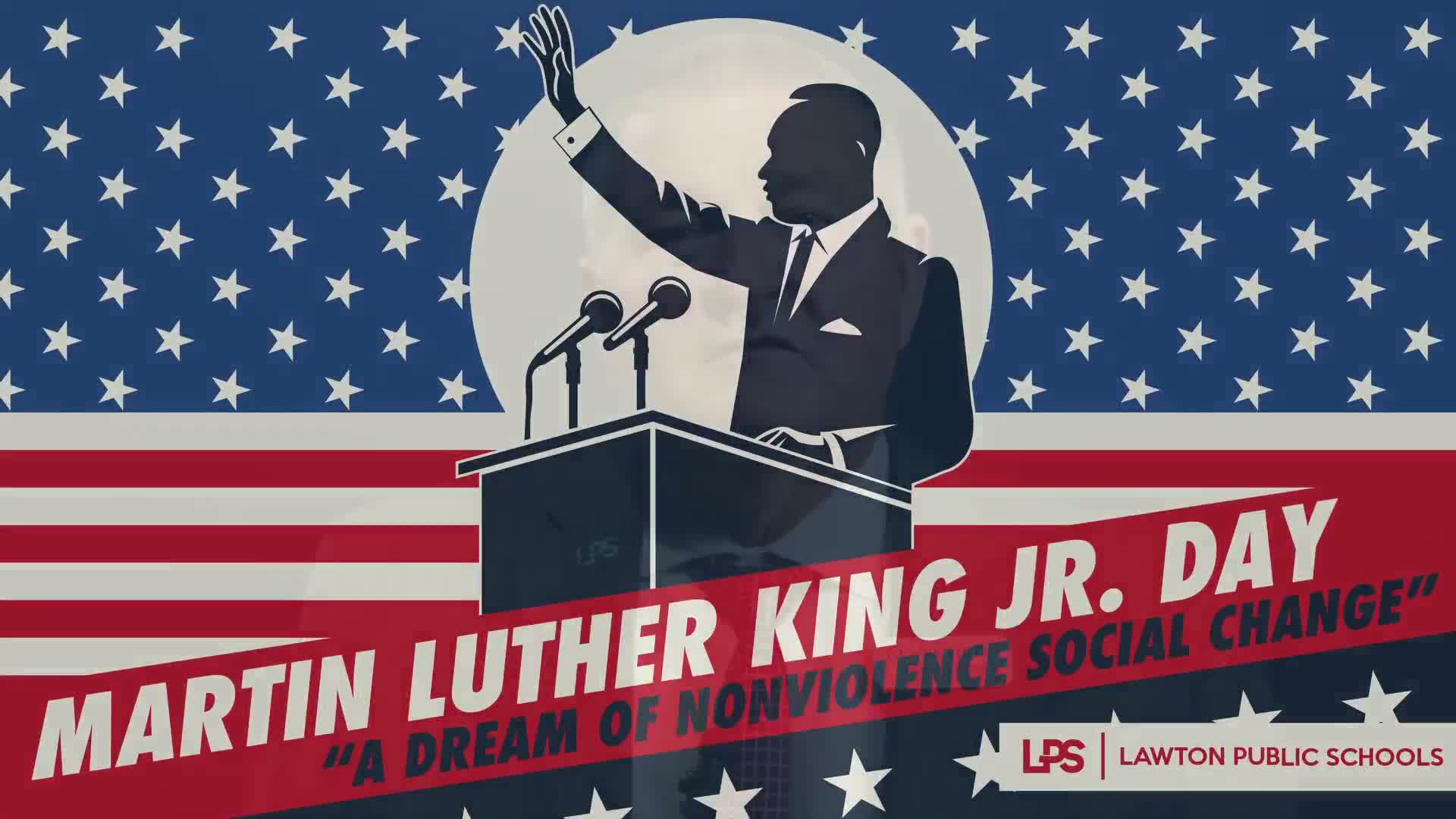
Summary
Lawton’s Jan. 19, 2026 commemoration featured readings of King’s speeches, a spoken-word performance, a student essay on nonviolent change, Comanche youth dances and presentation of community service awards and a lifetime service honor.
Lawton residents gathered on Jan. 19, 2026, to commemorate Martin Luther King Jr. with readings of his speeches, a spoken-word performance, student essays and community awards presented during a city program.
An unidentified program speaker opened the event by urging attendees to "live [King’s] words through kindness, fairness, and a commitment to standing up for another," and a reader recited passages from King’s "I Have a Dream" speech, including the line, "all men are created equal." Program presenters summarized King’s life—born Jan. 15, 1929; valedictorian at Crozer Theological Seminary in 1951; leader in the Montgomery bus boycott after Rosa Parks’s 1955 action; founder of the Southern Christian Leadership Conference—and noted his role in securing the Civil Rights Act of 1964 and the Nobel Peace Prize the same year.
Spoken-word performer Keyvon Howard delivered a piece titled "They prayed through," linking historical traumas such as lynching, the Tulsa Race Massacre and Rosewood to a message of resilience and faith. Howard said the community must keep "pressing forward" and "honoring our ancestors," connecting the historical record to present-day civic responsibility.
Ninth grader Patience Maley read an essay, "Creating Change with Respect and Compassion," arguing that nonviolent social change in Lawton requires education, community service, advocacy and respectful dialogue. "As a proud US citizen residing in Lawton, Oklahoma, I believe that meaningful and lasting social change must be rooted in nonviolence and respect for human dignity," Maley said.
Teresa, speaking for the Comanche youth dancers, described the group’s grand entry and subsequent dances—stick dance, snake dance and buffalo dance—explaining the buffalo dance as a tribute to the animal that provided food, medicine and clothing and describing the snake dance symbolically as renewal.
Dr. Cheryl Montz presented local awards. She named Renly Brooks, of Carriage Hills, as the elementary essay winner; Gianna, of MacArthur Middle School, as the middle-school winner; and Patience Maley of Eisenhower High School as the high-school winner. Community service awards recognized Gayla Taylor; the Lifetime Service Award was presented to Winona Alberti, founder of Josiah Prayer Ministry, for long-standing volunteer work and local charitable programs.
The program closed with an extended reading from King’s 1967 remarks about economic injustice, including the line: "There is a fire raging now for Negroes and the poor of this society," a passage used to frame contemporary calls for sustained, disciplined direct action to address poverty.
Organizers and speakers repeatedly emphasized nonviolence, intergenerational civic engagement and local service as ways to continue King’s legacy; the event combined historical reflection, cultural performance and community recognition and adjourned after the closing reading.