
Lake County Board of Review begins expedited review of wildfire resiliency and energy/building codes ahead of state deadlines
Get AI-powered insights, summaries, and transcripts
Subscribe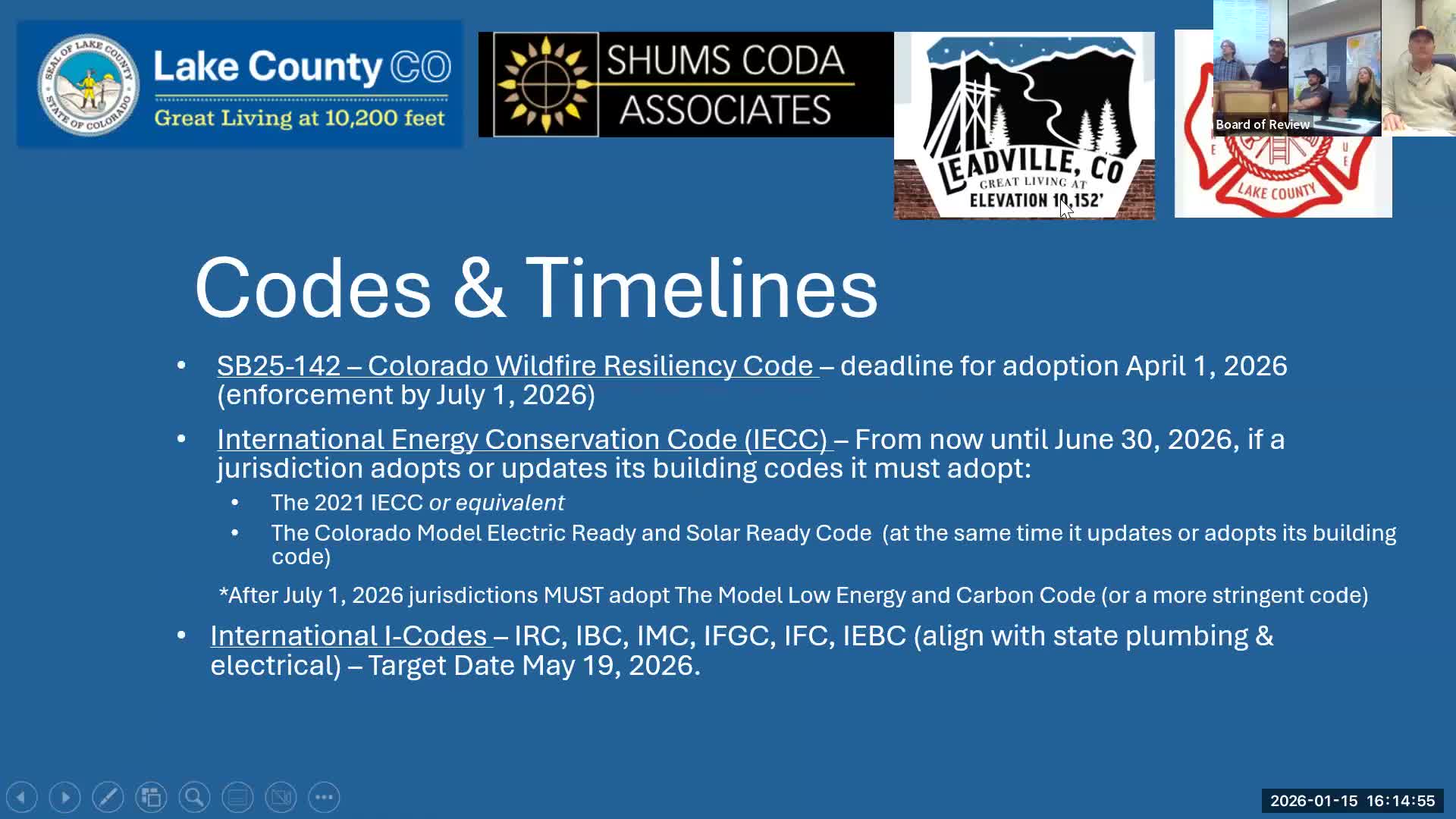
Summary
County staff and consultants briefed the board on adopting the Colorado Wildfire Resiliency Code and the choice between the 2021 and 2024 IECC and I‑codes; staff emphasized an April 1 deadline for wildfire code adoption and a June 30/July 1 sequence for energy code adoption and enforcement, and the board scheduled twice‑monthly follow‑ups.
Lake County staff and outside consultants presented detailed guidance to the Board of Review on adopting several sets of codes required or encouraged under recent state rules, with an urgent timeline driven by state adoption deadlines.
Staff said state legislation (referred to in the presentation as “Senate Bill 25 1 42”) requires jurisdictions to adopt a wildfire resiliency code and to act on energy‑code requirements. Barbara Rice of Stone’s COTA Associates described the Colorado Wildfire Resiliency Code as adapted from the 2024 International Wildland Urban Interface code to suit Colorado conditions and to "safeguard life and property" through structure hardening, defensible space and hazard mapping. She said the code focuses mainly on occupiable or habitable buildings and that the code’s triggers include additions greater than 500 square feet and major roof work (replacing or reroofing more than about 25% can trigger full roof upgrade requirements).
Consultants explained state mapping places most of Lake County into moderate and high hazard zones, which would require higher ignition‑resistant construction (class 2) for many projects, while noting that Leadville’s core city area was not mapped and could be treated differently. Barbara described a state 'ground‑truthing' process jurisdictions can use to request site‑specific reclassification of mapped parcels and said jurisdictions may establish local historic‑preservation exemptions if property or district status supports it.
Speakers discussed administrative choices for enforcement and review. Options include combining hardening inspections with standard building inspections, assigning plan review elements to building staff with fire personnel handling site reviews, using self‑reporting affidavits with follow‑up inspections, and leveraging peer reviews with neighboring jurisdictions. Dan Daley of Leadville/Lake County Fire Rescue emphasized the community risk, saying the code and hardening measures improve both resident and firefighter safety and that wildfire risk is a matter of timing: "It's not if," he said, referring to a major wildfire hazard.
On the building and energy codes, consultants compared the 2018, 2021 and 2024 editions of the I‑code family and IECC. They said the 2024 editions generally provide more administrative clarity (alternate means and methods), clearer third‑party listing/inspection pathways, more detailed guidance for energy storage systems (ESS) and additional performance‑based options. On ESS, presenters said listed systems (UL‑listed assemblies) are allowable inside dwellings up to a threshold (presenters cited a 20 kWh unit threshold that triggers fire‑code separation and stricter review); example products such as the Tesla Powerwall (noted in the presentation as about 16 kWh) were discussed as falling below that per‑unit threshold.
Hope Medina (energy and sustainability) reviewed IECC differences: the 2021 edition tightened thermal envelope R‑values vs the 2018 code, while the 2024 edition alters several values and compliance pathways (changing some ceiling R‑value requirements, adding continuous‑insulation options, expanding multifamily sampling rather than unit‑by‑unit testing, and creating an expanded additional‑efficiency/credit system). The 2024 also added provisions that could require renewable installations for certain commercial thresholds, though presenters said jurisdictions may amend that requirement out under state guidance.
Staff and consultants emphasized timing: the wildfire resiliency code was highlighted as urgent given an April 1 statutory trigger for adopting a wildfire code and a July 1 enforcement target tied to adoption timelines. For energy codes the presenters recommended adopting a 2021 or 2024 IECC pathway before June 30 to avoid defaulting later to a model low‑energy/carbon code that could impose stricter requirements. The board agreed to meet every other week (Wednesdays, 4–6 p.m. preferred) to advance draft ordinances/resolutions, plan public engagement and prepare materials for hearings.
Next steps recorded in the meeting: staff will circulate the slide deck and supporting links, collect follow‑up questions, prepare draft ordinance and resolution language for early March, and schedule a public town hall as part of community engagement before the public hearings in April–May.