Get Full Government Meeting Transcripts, Videos, & Alerts Forever!
Get email alerts on the Meadows Bailey Canyon Development topic
No spam. Unsubscribe anytime.
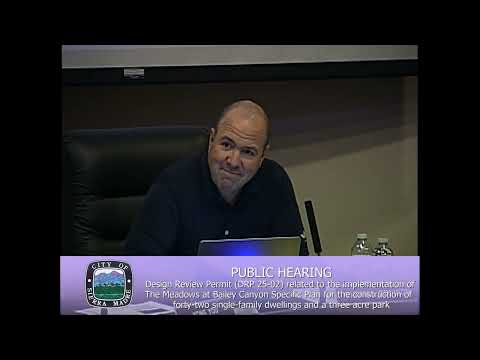
Sierra Madre planning panel approves design review for Meadows at Bailey Canyon, requires soil testing before grading
Summary
The Planning Commission approved Design Review Permit DRP25-02 on Jan. 15, 2026, clearing the way for 42 single‑family homes and a 3‑acre park in the Meadows at Bailey Canyon specific plan. The approval includes conditions requiring supplemental soil testing before grading amid resident concerns about post‑fire contamination and wildfire risk.
SIERRA MADRE, Calif. — The Sierra Madre Planning Commission on Jan. 15 approved Design Review Permit DRP25-02 for the Meadows at Bailey Canyon, authorizing the construction of 42 single‑family homes and a 3‑acre public park under the city’s adopted specific plan.
Senior Planner Wolfe told the commission the project ‘‘fully complies with the city’s general plan, zoning code, and specific plan design standards’’ as modified by recommended conditions, and that staff’s recommendation was to approve the permit with those conditions. The staff presentation cited the project’s prior approvals — including certification of the specific‑plan EIR on Sept. 9, 2022 — and said the application was deemed complete Dec. 22, 2025. The project site encompasses about 17.3 acres in northwest Sierra Madre; Toll West Coast LLC is the owner and Toll Brothers is the builder.
Why it matters: neighbors and public‑safety advocates testified that the Eaton Fire materially changed site conditions since the EIR and urged the city to require additional environmental review or at least independent, post‑fire soil testing before construction proceeds. Residents described displacement, testing on private properties showing metals such as lead and barium, and anxiety about excavation already observed on site.
‘‘I respectfully requested the city of Sierra Madre and all responsible agencies suspend further discretionary approvals for the Meadows housing project,’’ read part of a letter presented by Rob Fukuzaki on behalf of a neighbor, citing CEQA requirements for supplemental review. Nancy Beckham, who submitted the letter, and other residents argued that post‑fire changes to habitat, erosion and fire behavior could create new or more severe impacts not covered in the certified EIR.
Residents also gave firsthand accounts of health and safety concerns. Cheryl Fukuzaki said her family was displaced by the Eaton Fire and reported unsafe levels of lead in their home, asking directly: ‘‘Is the digging safe? Is there any contamination in there?’’ Dr. Christy Kaderi, who lives adjacent to the site, urged the city to require independent, site‑specific post‑fire soil testing and to clarify what permits authorized current excavation activity.
Applicant response: Jonathan Frankel, representing the project team, acknowledged community concerns and said the team ‘‘voluntarily agreed’’ to conduct supplemental soil testing and to share results with city staff before grading begins. When commissioners asked whether testing could be written as a condition, Frankel said staff and the project team were already coordinating to make soil testing a condition of the grading permit.
Conditions and code compliance: commissioners discussed several conditions of approval recommended by staff, including requiring shade trees in front yards consistent with the specific plan, screening of mechanical equipment, limits on materials per façade, and ensuring outdoor living features meet plan standards. Commissioners also raised the state’s forthcoming ember‑resistant "Zone 0" requirements (AB3074/Cal Fire implementation) and discussed adding Zone 0 compliance as a condition; the applicant said current plans avoid landscaping within five feet of structures and that homeowners’ covenants would enforce such measures.
Motion and vote: a commissioner moved to approve DRP25‑02 as amended during the meeting; the motion was seconded and carried unanimously. The commission confirmed staff will finalize the resolution and conditions of approval, and the next procedural steps include finalizing conditions, permitting, and grading‑permit review.
What remains: residents asked the city to consider supplemental environmental review under CEQA because of changed conditions after the Eaton Fire; staff maintained that the project qualified for a CEQA Class 3 exemption under section 15182 for residential projects implementing a certified specific plan but said exemption review includes confirming the project would not create new or more severe impacts than those disclosed in the EIR. The developer agreed to perform additional soil testing and make that testing a condition of grading, and staff said nine written comments had been received and were part of the record.
The Planning Commission noted the next available meeting for a continuance would be Feb. 19, 2026, but with the motion passed, staff will proceed to finalize conditions and coordinate grading permits and inspections consistent with the conditions adopted by the commission.